
Balancing workforce needs is critical for maintaining efficiency and profitability in any business. Overhiring can result in unnecessary expenses, reduced productivity, and difficulties in managing surplus staff. On the other hand, smart remote staffing provides a flexible solution that aligns resources with actual demand, thereby optimizing costs.
By understanding the financial and operational impacts of overhiring compared to strategic remote hiring practices, you can make informed decisions that support sustainable growth. Exploring these approaches helps you avoid common pitfalls and leverage modern staffing strategies effectively.
Key Takeaways
Overhiring leads to inflated costs, inefficiencies, and operational challenges, such as payroll strain, reduced profit margins, and slower decision-making.
Smart remote staffing offers a flexible solution by aligning workforce needs with demand while reducing overhead expenses like office space and equipment.
Remote staffing allows businesses to hire specialized talent on-demand for project-based or temporary work, avoiding the financial burden of full-time roles.
Transitioning from overhiring to smart staffing involves auditing current roles, identifying tasks suitable for remote execution, and implementing clear workflows for seamless integration.
Strategic remote hiring improves profitability, enhances operational agility, and enables reinvestment into growth areas like sales and client acquisition.
What Overhiring Looks Like in a Growing Marketing Agency
Overhiring can disrupt growth by inflating costs and creating inefficiencies. It often stems from misjudging workload needs or scaling without clear revenue alignment.
Expanding the Team too Early or too Fast
Adding employees before securing stable client demand strains budgets and resources. For example, hiring multiple account managers when only one is needed leads to underutilized staff. This overextension diverts funds from marketing, tools, or training that could drive actual growth.
Hiring Full-Time Roles for Inconsistent Workloads
Full-time hires for sporadic tasks like seasonal campaigns or ad-hoc projects result in wasted capacity. Instead of paying fixed salaries for inconsistent work, outsourcing specialists on demand ensures flexibility while controlling costs.
Inflated Overhead without Revenue Justification
Excessive staffing increases expenses such as office space, software licenses, and benefits packages. If revenue doesn’t grow proportionally, profit margins shrink. Smart remote staffing reduces these overheads by eliminating unnecessary physical infrastructure and offering scalable workforce options.
Hidden Costs of Overhiring
Overhiring creates financial and operational challenges that impact your agency’s efficiency. These hidden costs often go unnoticed until they strain resources or hinder growth.
Payroll and Benefits Strain on Cash Flow
Excessive hiring increases payroll expenses, including salaries, health insurance, retirement contributions, and other benefits. These fixed costs reduce flexibility during periods of fluctuating revenue. For example, if client retainers drop unexpectedly, maintaining oversized teams can deplete reserves faster than anticipated.
Decreased Profit Margins During Low Revenue Months
Hiring beyond workload needs shrinks profit margins when revenue dips. Fixed labor costs remain constant even when project volume decreases. This imbalance forces you to either cut into profits or take on unprofitable work just to cover team expenses.
Operational Bloat that Slows Decision-Making
Larger teams complicate workflows by adding unnecessary layers of communication and approval processes. Delays in decision-making affect campaign execution speed and client satisfaction. For instance, redundant roles can lead to overlapping responsibilities without improving output quality.
Burnout from Internal Misalignment or Role Redundancy
Overstaffing creates confusion about job duties, leading to misaligned priorities among team members. Employees may feel undervalued or frustrated if their roles overlap with others’. This dynamic fosters burnout while reducing overall productivity and morale within your agency.
What does Smart Remote Staffing Mean?
Smart remote staffing focuses on aligning workforce needs with business goals. It emphasizes flexibility, cost efficiency, and access to global talent without compromising output or quality.
Hiring for Output, Not Presence
Prioritize results over physical attendance by measuring employees based on deliverables. This approach eliminates unnecessary overhead tied to traditional office setups. For example, instead of hiring full-time in-house designers for sporadic projects, you can engage remote specialists who work per project milestones. By focusing on outcomes, you reduce wasted capacity and improve operational efficiency.
On-Demand Talent for Specialized or Temporary Work
Accessing skilled professionals only when needed optimizes costs and resources. For instance, hire SEO experts during a website overhaul or PPC managers for short-term campaigns rather than maintaining them year-round.
This strategy ensures you’re paying for expertise directly tied to specific objectives while avoiding the financial burden of permanent roles that may not consistently add value.
Building a Flexible Workforce That Scales with Demand
A scalable team adapts quickly to workload fluctuations without straining budgets. Use platforms like Upwork or Toptal to onboard freelancers during peak seasons or large client acquisitions. When demand decreases, scale back seamlessly without layoffs or excess payroll expenses. This model supports sustainable growth by balancing labor costs with revenue streams effectively.
Leveraging Long-Term Hires from Latin America
For ongoing operational roles that require consistency, hiring remote professionals from Latin America offers long-term value. With strong English proficiency, overlapping time zones, and competitive salary expectations, LATAM hires can serve as stable extensions of your core team.
Roles like project coordinators, content managers, and full-time designers can be filled by reliable talent without the overhead of U.S.-based salaries—offering continuity and cost control without compromising quality.
Cost Comparison: Overhiring vs Remote Staffing
Overhiring inflates costs and creates inefficiencies, while smart remote staffing optimizes expenses and aligns resources with demand. Comparing these approaches highlights the financial and operational advantages of remote hiring.
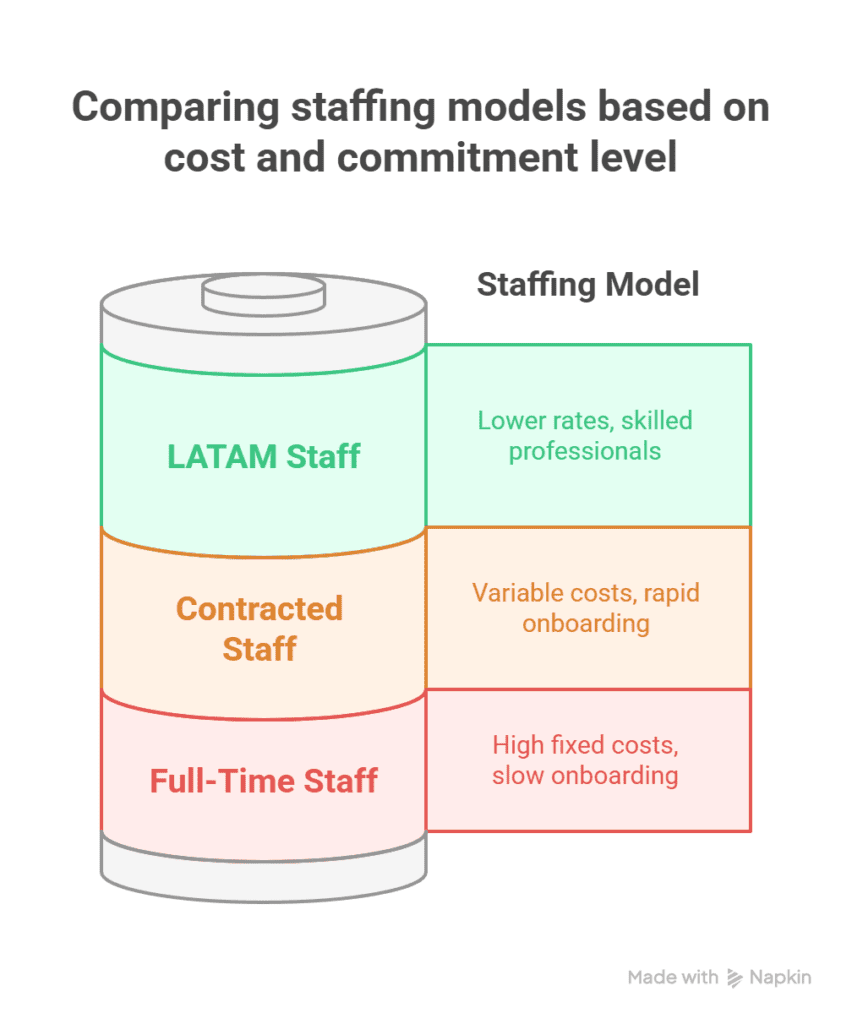
Full-Time Salary + Benefits vs Contracted Remote Rates
Full-time employees require fixed salaries, benefits like health insurance, paid leave, and retirement contributions. For example, a full-time marketing specialist in the US averages $65,000 annually plus 30% for benefits, totaling $84,500. In contrast, contracted remote professionals charge hourly or project-based rates without added benefit costs. Hiring a freelance marketer through platforms like Upwork can cost $40-$70 per hour depending on expertise—paying only for productive hours.
Infrastructure and Equipment Costs
Onsite staff increases infrastructure expenses such as office space rent, utilities, furniture, and equipment. Leasing an office for ten employees can exceed $5,000 monthly in urban areas. Remote workers use their own equipment and workspaces at no additional cost to you. This eliminates recurring overhead tied to physical operations while maintaining productivity.
Onboarding Time and Ramp-Up Differences
Traditional onboarding involves lengthy processes including training sessions, paperwork completion, and acclimating new hires to company culture—averaging 3-6 months before reaching full productivity. Remote contractors often start immediately due to prior experience with similar tasks or tools. Their familiarity reduces ramp-up time significantly when compared to permanent hires.
Risk Exposure During Client Loss or Seasonal Dips
Fixed payroll obligations strain budgets during revenue downturns caused by client losses or seasonal fluctuations. Overstaffing forces you into tough decisions like layoffs or absorbing unprofitable projects just to cover labor costs. With remote staffing models, scaling down is seamless—you pause contracts without long-term commitments or severance payouts impacting cash flow stability.
LATAM Rates: Competitive Costs Without Compromising Talent Quality
Hiring remote talent from Latin America provides access to highly skilled professionals at significantly lower rates than U.S.-based staff. Many roles—such as virtual assistants, content coordinators, or junior designers—start at around $10 per hour.
Even highly specialized roles like SEO strategists, media buyers, or technical project managers often range between $18 and $24 per hour. These rates reflect professional-grade talent fluent in English, experienced with U.S. workflows, and aligned in time zones—offering the same output quality for a fraction of the cost. For agencies aiming to scale profitably, LATAM is a high-efficiency staffing solution.
Roles Best Suited for Remote or Fractional Staffing
Certain roles align perfectly with remote or fractional staffing models, offering flexibility and cost savings without compromising quality. These positions often involve project-based tasks or specialized expertise.
SEO Specialists, Copywriters, Designers
SEO specialists analyze search data and optimize content remotely using tools like SEMrush or Ahrefs. Copywriters craft compelling text for campaigns, websites, and emails without needing in-office collaboration. Designers create visuals such as logos, social media graphics, and web layouts independently using platforms like Adobe Creative Suite. Remote work ensures access to global talent while reducing overhead costs.
Paid Media Assistants and QA Reviewers
Paid media assistants manage ad campaigns on platforms like Google Ads or Facebook Business Manager by monitoring performance metrics and adjusting strategies online. QA reviewers test digital assets—websites, apps, or email templates—for errors before launch. Both roles rely on clear guidelines rather than physical presence, making them ideal for remote execution.
Project-Based Developers and Automators
Developers handle coding projects such as website builds or app development within defined timelines using GitHub or similar tools. Automators streamline workflows by implementing software solutions like Zapier or Integromat to reduce manual processes. These professionals deliver measurable results efficiently through virtual collaboration channels.

Strategic Benefits of Remote Staffing for Agencies
Remote staffing offers agencies flexibility and cost control while maintaining access to skilled professionals. It aligns workforce needs with project demands, ensuring efficiency without unnecessary overhead.
Maintain Delivery Capacity Without Long-Term Commitment
Remote marketing staffing ensures you can scale your team up or down based on workload. Instead of committing to full-time salaries during slow periods, you engage specialists only when needed.
For example, hiring a remote developer for a three-month project avoids ongoing payroll costs after the project’s completion. This approach minimizes financial risks and keeps resources aligned with revenue-generating activities.
Reinvest Savings into Growth Areas (Sales, Client Acquisition)
Savings from reduced overhead and infrastructure costs can fund growth initiatives. Redirecting these funds allows you to invest in lead generation tools, client acquisition campaigns, or sales training programs. For instance, using savings from remote SEO specialists could finance advanced CRM software or targeted ad campaigns that drive new business opportunities.
Reduce Hiring Time and Improve Operational Agility
Hiring remote contractors shortens recruitment timelines by focusing on pre-vetted talent pools. Unlike traditional hires requiring lengthy onboarding processes, experienced freelancers often start contributing immediately. This agility helps you meet tight deadlines or pivot quickly during market changes without compromising delivery quality or overextending internal teams.
How to Transition from Overhiring to Smart Staffing
Shifting from overhiring to smart staffing improves profitability and operational efficiency. Focus on aligning workforce needs with business goals while minimizing unnecessary expenses.
Audit Existing Roles by Workload and ROI
Evaluate each role based on workload consistency and measurable return on investment (ROI). Identify underutilized positions or roles with low output relative to their cost. For example, if a full-time designer handles sporadic projects, consider replacing the position with a remote contractor. Use data like project completion rates and revenue contribution to guide decisions.
Identify Functions That Can Shift to Remote
Pinpoint tasks that don’t require in-office presence but demand specialized skills. Common examples include SEO strategy, paid media management, content writing, and development work. Assess whether these functions are project-based or ongoing but flexible enough for remote execution. Shifting such roles reduces overhead costs tied to office space and equipment.
Build SOPs and Tool Access for Remote Talent Integration
Create standard operating procedures (SOPs) detailing workflows, communication protocols, and performance expectations for remote workers. Provide access to essential tools like project management software (e.g., Asana), file-sharing platforms (e.g., Google Drive), and team communication apps (e.g., Slack). Clear guidelines ensure seamless collaboration between in-house teams and remote talent.
Partner with a Remote Marketing Staffing Agency in LATAM
Working with a specialized marketing staffing agency in Latin America streamlines the transition to a leaner, more efficient team structure. These agencies offer pre-vetted talent experienced in digital marketing roles such as SEO, paid media, email automation, and content production—ready to plug into your workflows.
This approach reduces hiring time, minimizes risk, and ensures you’re getting professionals who are aligned with your time zone, fluent in English, and trained in tools your agency already uses. It’s a strategic move that balances agility with quality execution.
Final Thoughts
Overhiring can strain your resources, inflate costs, and hinder long-term growth. By adopting a smart remote staffing approach, you gain the flexibility to scale efficiently while aligning workforce needs with business goals. This strategy not only reduces overhead but also ensures access to specialized talent without unnecessary commitments.
Shifting to a more agile staffing model allows you to focus on profitability and operational efficiency. With careful planning and the right tools in place, you can build a leaner, more adaptable team that drives sustainable success for your business.
If you need help building a remote marketing team, Wow Remote Teams is the right choice for your agency. We have helped big companies source and hire top talent for a fraction of the cost and in 3-5 days.
📚 Recommended Reading for Agency Founders
➤ Benefits of Partnering with a Staffing Agency for Digital Marketing Firms
➤ Business Development for Marketing Agencies
➤ From 2 Clients to 10: How to Use Remote Staff to Grow Fast
➤ Freelancer vs Remote Staff: What’s Better for Growing Agencies?
➤ Top Roles Digital Marketing Agencies Nearshore to Latin America
➤ How to Overcome Marketing Talent Scarcity for Your Agency
➤ Affordable Remote Staffing Solutions for Agencies Under 10 People
➤ What to Do When You Can’t Hire Fast Enough
➤ Top Remote Roles Every 50-Person Agency Should Have on Call
➤ How to Hire Remote Talent from LATAM for Your Digital Marketing Agency
➤ Outsourcing Creative: What’s Safe to Offload and What’s Not
Frequently Asked Questions
What is overhiring, and why is it a problem for businesses?
Overhiring occurs when companies hire more employees than necessary to meet workload demands. This leads to inflated payroll costs, reduced productivity due to inefficiencies, and strained resources. Overstaffing can also shrink profit margins by increasing overhead expenses without a corresponding rise in revenue.
How does overhiring affect business growth?
Overhiring disrupts growth by creating financial strain through excessive fixed labor costs. It complicates workflows, slows decision-making, and reduces operational flexibility during revenue fluctuations. These challenges hinder scalability and profitability.
What is smart remote staffing?
Smart remote staffing involves hiring remote professionals based on specific project needs rather than full-time roles. It offers flexibility, cost efficiency, access to global talent, and eliminates infrastructure expenses associated with onsite staff.
Why is remote staffing more cost-effective than traditional hiring?
Remote staffing reduces costs by eliminating the need for office space, equipment, and benefits typically provided to full-time employees. Businesses pay only for completed work or specific projects instead of incurring ongoing payroll obligations.
Which roles are best suited for remote or fractional staffing?
Roles like SEO specialists, copywriters, designers, paid media assistants, QA reviewers, developers for project-based tasks, and automation experts are ideal for remote or fractional staffing due to their specialized nature and flexible workloads.
How does remote staffing improve operational agility?
Remote contractors often start immediately due to prior experience. This shortens onboarding time and allows businesses to scale teams quickly based on workload demands while maintaining quality standards.
Can remote staffing help during revenue downturns?
Yes. Remote staffing provides flexibility by allowing businesses to scale down workforce needs without long-term commitments or severance payouts. This minimizes financial risks during periods of fluctuating revenue.
How can businesses transition from overhiring to smart staffing?
Businesses should audit existing roles for workload consistency and ROI. Identify underutilized positions that can shift to remote work (e.g., content writing). Implement standard operating procedures (SOPs) and provide tools for seamless collaboration between in-house teams and remote workers.
What are the strategic benefits of adopting a remote workforce model?
A remote workforce enables cost control, faster recruitment timelines, access to skilled professionals globally, improved delivery capacity without long-term commitments, and reinvestment opportunities into growth initiatives like lead generation campaigns.
How does smart staffing support sustainable business growth?
By aligning workforce needs with business goals while minimizing unnecessary expenses such as overhead costs from overstaffing. Smart staffing ensures efficient resource allocation that promotes scalability without compromising profitability or quality.