
You Don’t Need to Code to Hire Great Developers—You Need a Smarter Hiring Method
Hiring tech talent can feel like uncharted territory, especially if you don’t come from a technical background. But here’s the truth: you don’t need to write code to evaluate those who do. You need a clear process, sharp criteria, and the right tools.
Great developers aren’t defined by jargon—they’re defined by how they solve problems, communicate with teams, and deliver results. Focus on what matters: their track record, how they approach challenges, and whether their experience matches your business needs.
With structured assessments, real-world tasks, and expert guidance, you can make confident hiring decisions without pretending to be an engineer. Think about it, the ability to bridge business strategy with technical hiring is a competitive advantage.
This guide will show you how to do it right. No coding required. Just smart decisions.
Key Takeaways
- Non-technical professionals can effectively assess tech talent by focusing on problem-solving skills, communication abilities, and relevant experience rather than technical expertise.
- Leverage tools like LinkedIn Recruiter, GitHub, and ATS platforms to source candidates and streamline the hiring process. Use coding tests from providers like HackerRank or Codility for skill validation.
- Collaborate with engineering managers or IT recruitment agencies to ensure accurate technical assessments while saving time and resources.
- Understand core competencies of tech roles by mapping responsibilities to deliverables and familiarizing yourself with essential tech stacks (e.g., Python, AWS).
- Identify red flags in resumes such as frequent job changes, vague descriptions, or inflated claims; evaluate public contributions on platforms like GitHub for practical insights into a candidate’s skills.
- Ask scenario-based questions during interviews to assess logical reasoning, problem-solving approaches, and real-world application of skills without requiring coding knowledge.
Why Non-Technical Professionals Need to Assess Tech Talent
Hiring managers and IT recruiters without an engineering background are often the first line of defense in tech hiring, and they matter more than they think. When the right assessment process is in place, even non-technical teams can hire developers who deliver.
A well-structured approach reduces guesswork, aligns recruitment with business goals, and helps avoid costly mis-hires. The result? Stronger teams, faster onboarding, and better performance where it counts.
Can you recruit developers without knowing how to code?
Yes, recruiting developers is possible without coding knowledge by leveraging structured processes and specialized tools. Use platforms like LinkedIn Recruiter, GitHub, or Stack Overflow for sourcing candidates based on their contributions and activity. Employ ATS systems to streamline candidate shortlisting.
Focus on evaluating problem-solving skills, communication abilities, and cultural fit during interviews. Collaborate with engineering managers or CTOs for technical validation through coding tests. Outsourcing assessments to IT recruitment agencies also ensures accurate skill evaluation while saving time.
How do non-tech people hire software engineers?
Non-technical professionals hire software engineers by combining clear job descriptions with strategic hiring pipelines. Start by defining the required tech stack (e.g., Python, AWS) and outlining specific roles like Full-Stack Developer or QA Analyst. Post detailed listings on relevant platforms like niche communities.
Screen resumes for relevant experience using Boolean search techniques within sourcing tools. Conduct initial interviews focusing on soft skills such as teamwork and adaptability before passing candidates to technical sourcers for deeper evaluation. Carry out pre-vetted screening tests from providers to assess core competencies efficiently.
Partnering with IT staffing firms specializing in nearshore or offshore markets (e.g., Latin America or Eastern Europe) expands access to bilingual, remote-ready talent pools while reducing time-to-hire metrics.
Understanding the Core Competencies of Tech Roles
Identifying core competencies in tech roles ensures you align candidates with your project needs. This approach reduces mismatches and optimizes team performance.
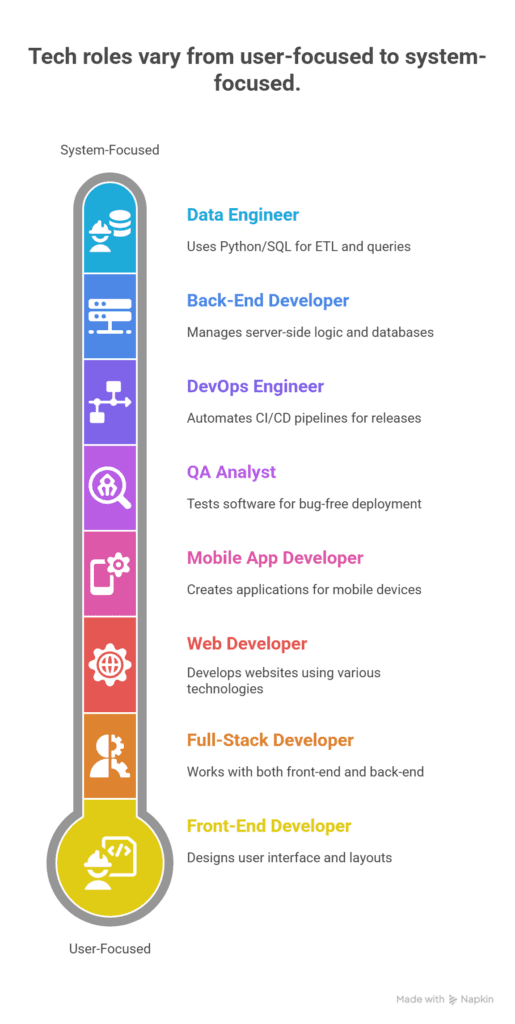
Mapping roles to responsibilities and output
Defining role-specific deliverables clarifies expectations for both IT recruiters and hiring managers. For example, a Front-End Developer focuses on user interface design and responsive layouts, while a Back-End Developer handles server-side logic and database management. A QA Analyst tests software functionality to ensure bug-free deployment, whereas a DevOps Engineer automates CI/CD pipelines for faster releases.
Collaborate with technical sourcers or engineering managers to map job descriptions accurately. Use structured interview rubrics that evaluate problem-solving skills, coding proficiency, and task ownership relevant to each role’s scope. Some platforms can simulate real-world scenarios for assessing candidate capabilities effectively.
Basic knowledge of tech stacks and tools
Understanding essential tech stacks helps you assess compatibility between candidates’ skillsets and your requirements. For instance, Full-Stack Developers often work with JavaScript frameworks like React (front-end) and Node.js (back-end). Data Engineers frequently use Python for ETL processes or SQL for database queries.
Familiarize yourself with the common tools used by different roles.
Web Developers may rely on GitHub for version control, while Mobile App Developers might prioritize Swift (iOS) or Kotlin (Android). Leverage sourcing tools such as LinkedIn Recruiter or Stack Overflow Talent to identify professionals proficient in these technologies.
Partnering with an IT recruitment agency can also provide pre-vetted talent pools aligned with specific tech stack demands.
The 30-Minute Technical Deep Dive (Even Non-Technical Recruiters Can Use)
You don’t need to write code to assess how someone thinks. One tactic consistently delivers clarity: the structured 30-minute deep dive. Choose one past project from the candidate’s résumé and unpack it.
Ask them to walk you through the challenge, the architecture, the trade-offs, and the result. Take note of how they explain complexity. Do they understand the why behind the code, or just the syntax?
You’re not testing their hands, you’re testing their thinking. The best developers explain tough problems simply. That’s how you know they solved them.
Aligning Candidate Experience With Stage-Specific Needs
A senior developer may thrive in a mature engineering team but struggle in an early-stage startup lacking structure. Likewise, a strong junior developer may underperform without proper mentorship. Match candidates not only to roles but to your team’s stage of growth.
In early-stage environments, prioritize versatility, ownership, and comfort with ambiguity. In growth-stage teams, focus on depth of expertise, process adherence, and collaboration at scale. This alignment reduces turnover and improves delivery velocity.
Evaluating Technical Communication, Not Just Technical Skill
Strong developers communicate clearly with cross-functional teams. During interviews, assess how well candidates explain technical decisions to non-technical stakeholders.
Ask how they’ve handled misalignment with product managers or changes in project scope. Look for structured thinking, not rehearsed jargon. Developers who articulate trade-offs without overcomplicating are often better collaborators—and easier to manage.
Red Flags in Tech Resumes and LinkedIn Profiles
Identifying red flags in tech resumes and LinkedIn profiles helps you avoid unqualified candidates early in the hiring pipeline. By focusing on specific patterns, public contributions, and keyword usage, you can streamline your technical hiring process.
Patterns that signal instability or skill gaps
Frequent job changes over short periods indicate a lack of commitment or adaptability issues. For example, if a Software Developer has worked at five companies within two years without clear project-based roles, this suggests instability.
Unexplained employment gaps longer than six months raise concerns about skill stagnation unless justified by certifications or freelance projects during that time.
Generic role descriptions like “worked on various tasks” instead of specifying deliverables such as “developed scalable APIs for e-commerce platforms” suggest limited technical expertise.
How to evaluate public contributions
Public contributions on GitHub, Stack Overflow, or similar platforms demonstrate practical skills and problem-solving abilities. Check their GitHub repositories for recent commits; active participation indicates ongoing learning and engagement with coding standards.
Review Stack Overflow profiles for upvotes on answers related to relevant technologies. High-quality responses reflect deep understanding rather than surface-level knowledge.
Assess open-source project involvement by verifying pull requests merged into significant repositories. Contributions to frameworks like React.js or Kubernetes showcase advanced capabilities applicable to real-world scenarios.
Keywords that may indicate copy-pasted resumes
Overuse of buzzwords like “team player,” “innovative thinker,” or “results-driven” without context signals generic templates. Instead, look for measurable achievements such as “reduced server response time by 30% using Node.js optimizations.”
Repeated mentions of multiple unrelated tech stacks (e.g., Python, JavaScript, Ruby) without corresponding experience listed under work history imply inflated claims.
Vague phrases like “familiar with cloud technologies” instead of specifics such as “deployed AWS Lambda functions for serverless architecture” highlight potential exaggerations or lack of hands-on experience.
How to Ask Smart Questions (Even if You Don’t Know the Answers)
Asking relevant questions during technical interviews helps you evaluate candidates effectively, even without coding expertise. Focus on understanding problem-solving approaches, communication clarity, and practical experience.
What questions should I ask a developer if I’m not technical?
Frame your questions around project outcomes, collaboration methods, and decision-making processes. For example:
- Project Impact: “Can you describe a recent project where your work directly improved performance or user experience? What metrics did you track?”
- Problem-Solving: “How do you approach debugging complex issues in production environments?”
- Team Collaboration: “What tools or practices do you use to ensure smooth communication with non-technical stakeholders?”
These questions highlight how candidates apply their skills in real-world scenarios. Use follow-ups like “Why did you choose that approach?” to assess depth of thought.
How to assess developer thinking without coding knowledge?
Evaluate logical reasoning by asking scenario-based questions tied to role-specific challenges. For instance:
- For Back-End Developers: “If an API request takes too long to respond, what steps would you take to identify and resolve the bottleneck?”
- For QA Analysts: “How would you prioritize test cases for a high-risk feature release under tight deadlines?”
- For DevOps Engineers: “What strategies do you carry out to optimize CI/CD pipelines for faster deployments?”
Request explanations in simple terms. This ensures candidates can articulate complex concepts clearly—a key skill when working with cross-functional teams.
Use specialized platforms for objective assessments of coding proficiency if needed. Collaborate with IT recruitment agencies or engineering managers for validation when assessing advanced tech stacks or niche roles like LLM Post-Training Specialists.
The Smartest Way to Hire Tech Talent—Without Guesswork
If you’re hiring developers without a technical background, the right recruitment partner makes all the difference. Not just someone who sends résumés, but a team that understands what your business needs and delivers candidates who can do the job.
That’s where Wow Remote Teams comes in.
We help CTOs and hiring managers across the U.S. connect with top tech talent from Latin America—and start interviewing in just 3 business days. Pre-vetted. Time zone aligned. Ready to contribute.
Stop sifting through resumes. Start meeting qualified professionals who fit your team.
Get in touch today or request a role to see how we can help you build a stronger tech team—without the guesswork.
Recommended Resources
- Top IT Recruitment KPIs
- IT Recruitment: Agency vs In-House vs Freelancers
- Structured Technical Interview Frameworks
- Top Countries to Hire IT Talent in LATAM
- Nearshore vs Offshore IT Hiring
- Common Challenges in IT Recruitment
- Top IT Roles Companies Hire in Latin America
- IT Recruitment Guide for CTOs and Founders
Frequently Asked Questions
1. Can I hire tech talent without knowing how to code?
Yes, you can hire tech talent without coding knowledge by focusing on problem-solving skills, communication abilities, and relevant experience. Use structured assessments, scenario-based questions, and collaborate with technical experts for validation.
2. How do I evaluate a developer’s skills if I’m not technical?
You can use tools like HackerRank or Codility for objective skill assessments. Additionally, review their portfolio (e.g., GitHub) and ask about real-world project outcomes during interviews.
3. What should I include in a job description for tech roles?
Clearly outline responsibilities, required skills, preferred technologies, and measurable expectations for the role. Collaborate with technical experts to ensure accuracy.
4. How can I identify red flags in tech resumes?
Look out for frequent job changes, unexplained employment gaps, generic descriptions of roles, and overused buzzwords. Focus on measurable achievements and specific examples of work.
5. Should non-technical hiring managers partner with IT recruiters?
Yes, partnering with IT recruiters provides access to pre-vetted candidates and ensures alignment with your business needs through expert validation.
6. What are some smart interview questions for assessing developers?
Ask about project impact, collaboration methods, decision-making processes, and problem-solving approaches. Scenario-based questions tailored to the role are also effective.
7. How do I screen resumes effectively without a technical background?
Use Boolean search techniques to filter resumes based on keywords related to the role’s requirements. Look for evidence of relevant experience and practical contributions on platforms like GitHub or Stack Overflow.
8. Why is understanding core competencies important when hiring tech talent?
Understanding core competencies helps align candidates’ skills with project needs, reducing mismatches and improving team performance.
9. Are there tools that help assess coding proficiency objectively?
Yes, platforms like HackerRank or Codility provide standardized tests to evaluate coding proficiency objectively across various programming languages.
10. How can collaborating with engineering managers improve hiring decisions?
Engineering managers bring deep technical expertise that helps validate candidates’ skills accurately while ensuring alignment with your team’s goals and technology stack requirements.