
Startups often see remote hiring as a quick way to scale while keeping costs manageable. The reality is that many founders move too fast and overlook critical steps such as compliance, proper onboarding, or choosing the right sourcing channels. These gaps can lead to high turnover, payroll errors, and wasted time.
A structured remote hiring checklist helps avoid those problems. It ensures that every stage — from writing a role description to setting up payroll — is consistent and legally sound. The goal is not only to hire quickly, but to build a process that supports long-term growth.
The following checklist provides a step-by-step framework that any startup can apply immediately. It covers preparation, candidate evaluation, compliance, and onboarding in a logical sequence, so founders can save time and reduce hiring risks.
The Complete Remote Hiring Checklist for Startups
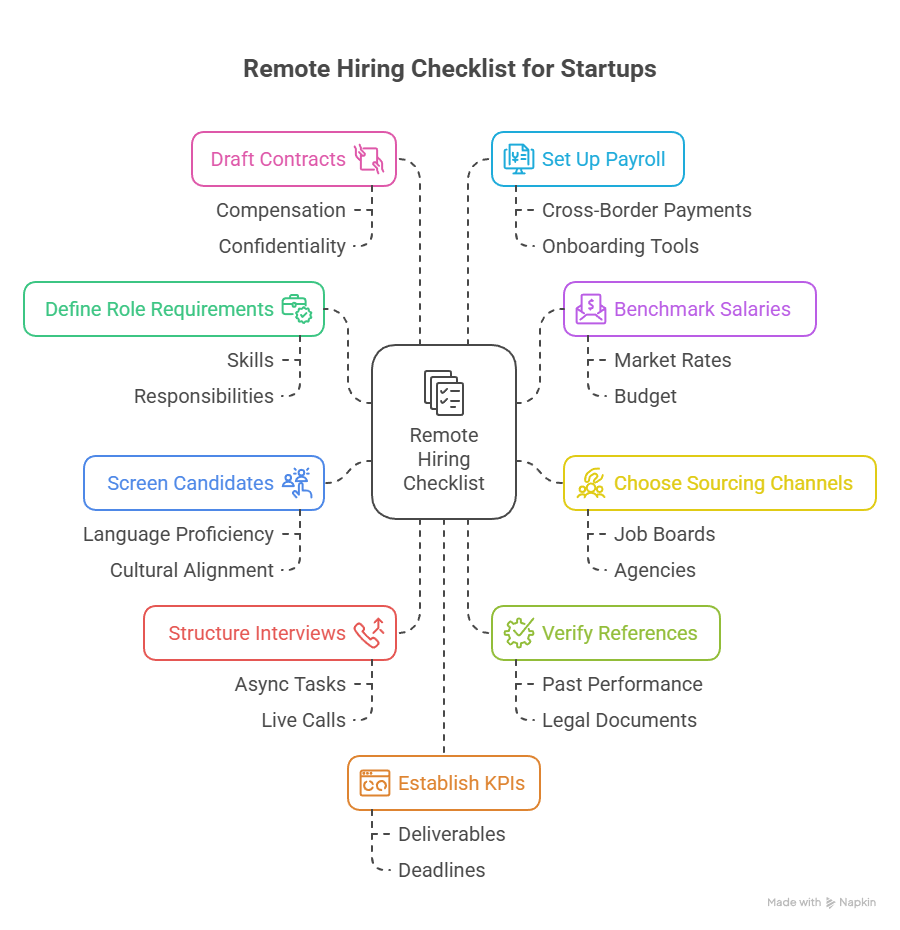
1. Define role requirements with remote-first job descriptions
Start by clarifying what the position requires in terms of skills, responsibilities, and outcomes. A remote-first job description should also specify working hours, communication expectations, and the tools the employee will use (e.g., Slack, Asana, HubSpot). This helps filter out candidates who are not prepared for distributed work.
2. Benchmark salaries and set a budget
Research market rates for the role across different regions. Tools such as Glassdoor, Payscale, or regional salary reports provide benchmarks. For startups hiring internationally, it’s important to balance cost savings with fair pay that attracts qualified candidates. Decide on a salary range before sourcing to avoid delays or mismatched expectations.
3. Choose sourcing channels (job boards, agencies, referrals)
Identify where your ideal candidates spend their time. General job boards (LinkedIn, Indeed), startup-focused platforms (AngelList), and specialized staffing agencies are common sources. Employee referrals can also bring strong candidates with built-in trust. Document which channels are most effective for your startup to refine future hires.
4. Screen for English, skills, and cultural alignment
A structured screening process should combine language proficiency, technical skill testing, and cultural fit. For startups, cultural alignment is often as important as skills — a mismatch here can lead to early turnover. Screening tools, short technical tests, or structured questionnaires can standardize this step.
5. Structure interviews (async tasks + live calls)
Combine asynchronous tasks (short assignments, recorded responses) with live interviews. This reduces scheduling delays across time zones and gives you a clear view of how candidates communicate and problem-solve. Live calls should confirm skills, clarify expectations, and test collaboration style.
6. Verify references and legal documentation
References provide insight into past performance and reliability. In addition, always collect and verify legal documents, such as proof of identity, certifications, or previous employment. This protects the startup from misclassification issues and ensures compliance with local laws.
7. Draft compliant contracts and NDAs
Use contracts that reflect international hiring laws. Define terms around compensation, termination, confidentiality, and intellectual property. A well-drafted Non-Disclosure Agreement (NDA) protects sensitive information, which is particularly important for early-stage startups working on proprietary ideas.
8. Set up payroll and onboarding tools
Choose a payroll solution that handles cross-border payments while staying compliant with tax and labor laws. Platforms like Deel or Papaya Global simplify this process. For onboarding, provide access to tools (project management, communication, document storage) on the first day to reduce downtime.
9. Establish KPIs and performance expectations
From the start, clarify how performance will be measured. Define metrics such as deliverables, deadlines, or client feedback scores. Clear KPIs help remote employees stay accountable and give startups a structured way to assess contributions without micromanagement.
Why Startups Need a Remote Hiring Checklist
A hiring checklist is not just paperwork. For startups, it acts as a safeguard against mistakes that can slow growth or create legal risk. When startups skip structured steps, the result is often high turnover, wasted payroll, and compliance problems.
Misclassification risks: Hiring remote workers without proper contracts can lead to treating them as contractors when they legally qualify as employees. Employment laws vary by country, and misclassification exposes startups to fines, back pay, or tax liabilities.
Hidden payroll costs: Global payroll is more complex than simply sending payments. Tax withholdings, benefits, and mandatory contributions must be calculated correctly. A checklist ensures nothing is missed.
Onboarding gaps: A new employee who does not receive proper onboarding is likely to feel disconnected. In a distributed team, onboarding becomes even more critical for retention and productivity.
Scaling challenges: Without a defined hiring process, startups spend excessive HR time repeating tasks from scratch. A remote hiring checklist standardizes best practices so every new hire is treated consistently.
Pre-Hiring Preparation for Remote Teams
Startups need to prepare before publishing a job ad. This preparation phase sets the foundation for finding and retaining top talent.
Clarify startup growth goals
Determine whether the hire is for immediate execution or future growth. Early-stage startups often confuse urgent tasks with long-term needs, leading to the wrong hires. Document expected outcomes and how the role connects to company goals.
Nearshore vs offshore decisions
Time zone overlap affects collaboration. Nearshore hiring allows for real-time meetings, while offshore hiring may reduce costs but limits live collaboration. Cultural fit also matters; aligning communication styles with existing team habits reduces friction in remote work.
Salary benchmarks and cost comparisons
Compensation data is essential for budgeting. Compare local salaries with international markets to find sustainable options. For example, nearshore recruitment may offer a balance between lower costs and strong English proficiency. By using salary benchmarks, startups can create competitive offers without overspending.
This preparation step reduces wasted effort later in the hiring process and ensures that sourcing is focused on the right candidate profile.
Building Your Remote Hiring Checklist in Detail
Once preparation is complete, each step of the checklist must be executed with attention to both compliance and employee experience.
Job descriptions tailored for remote skills
Write job descriptions that go beyond technical skills. Include expectations for communication, self-management, and use of remote tools. A well-crafted description filters applicants who are not ready for distributed work.
Talent sourcing strategies
Rely on a mix of job boards, recruitment agencies, and referrals. For startups, agencies specializing in remote hiring can save weeks of effort by pre-screening candidates. Document which sources deliver the most qualified applicants to refine the process over time.
Screening for technical + soft skills
Use structured assessments to test both hard and soft skills. Technical tasks confirm ability, while cultural questions reveal how a candidate will interact with the team. A new hire with poor communication skills will often cause more problems than a candidate with minor technical gaps.
Contracting and compliance issues
Contracts should be written in compliance with employment laws of both the startup’s country and the employee’s country. Define terms around intellectual property, confidentiality, and termination. This protects both parties and reduces the risk of disputes.
Onboarding systems and productivity tools
A checklist should include a clear onboarding process. Provide access to accounts and tools before the first day. Use templates for onboarding schedules so that each new employee feels welcomed and prepared. Productivity improves when employees start with clarity instead of confusion.
Tools and Resources for Remote Hiring Success
The hiring process is supported by technology that simplifies sourcing, compliance, and HR tasks.
- LinkedIn Jobs & AngelList – useful for sourcing top talent in startup ecosystems.
- Deel & Papaya Global – handle payroll and employment compliance across borders.
- BambooHR – manages HR records and new hire data in one system.
- Slack & Asana – essential for onboarding and day-to-day remote work.
Using these tools ensures consistency and reduces administrative errors. For startups with limited HR capacity, partnering with a recruitment agency that specializes in remote work can be even more efficient.
Wow Remote Teams as a startup solution
For founders who cannot afford weeks of sourcing and vetting, Wow Remote Teams provides pre-screened candidates across marketing, sales, and technical roles. The agency manages sourcing, interviews, and compliance support, allowing startups to focus on growth while avoiding hiring mistakes.
Common Remote Hiring Mistakes Startups Must Avoid
Even with a structured checklist, mistakes still happen. Being aware of them helps startups protect time and resources.
Hiring too quickly without clarity
Skipping role definition leads to mismatched hires. Every new employee should have clear deliverables tied to company goals before sourcing begins.
Overlooking compliance with employment laws
Not all hires can be legally classified as independent contractors. Misclassification is one of the most common issues in remote work, and penalties can be severe. Always align contracts with local laws and, when possible, use payroll providers that specialize in cross-border employment.
Neglecting onboarding
Remote workers who do not receive structured onboarding often feel isolated or confused about expectations. This reduces retention and productivity. Always assign onboarding tasks, schedule introductory calls, and provide tool access on day one.
Failing to set performance measures
Without KPIs, it becomes difficult to know if a hire is adding value. Define measurable goals early to help the employee feel guided and the startup maintain accountability.
By learning from these mistakes, startups can create a hiring process that not only brings in top talent but also builds a foundation for retention and long-term growth.
Building a Reliable Remote Hiring Process
Hiring remotely gives startups access to global talent while controlling costs, but success depends on structure. A remote hiring checklist keeps the process consistent — from defining roles and sourcing candidates to compliance, onboarding, and performance management. Using a template ensures that every new hire is handled with the same best practices, regardless of role or region.
Startups with limited HR resources don’t need to manage everything alone. Agencies like Wow Remote Teams specialize in connecting U.S. startups with vetted professionals across marketing, sales, and technical roles. With sourcing, screening, and compliance support already in place, founders can focus on growth instead of administrative tasks.
👉 If you want to avoid hiring mistakes and start interviewing qualified candidates within days, schedule a call with Wow Remote Teams today.