
Struggling to get the most out of your real estate team? You’re not alone. Many real estate business owners face the challenge of aligning their staffing strategies with measurable results, leaving potential profits on the table.
Imagine having a clear roadmap to track employee productivity, reduce hiring costs, and improve retention rates—all while boosting your bottom line. The right KPIs and ROI benchmarks can transform your team’s performance and help you stay ahead in a competitive market.
Don’t let inefficiencies hold your business back. Discover how tracking the right metrics can unlock actionable insights, streamline operations, and drive profitability like never before.
What Are Staffing KPIs?
Staffing KPIs are quantifiable metrics that track key aspects of workforce management. Examples include time-to-fill vacancies, cost per hire, turnover rate, and employee satisfaction scores. Each KPI highlights specific areas for improvement in recruitment or team operations.
Time-to-fill measures how quickly you can fill open positions. Cost per hire calculates the total expense incurred during the hiring process. Turnover rate identifies how often employees leave within a given period. Employee satisfaction scores gauge overall morale through surveys or feedback tools.
What is the Importance of Staffing KPIs In Real Estate?
Tracking staffing KPIs ensures your team operates efficiently to meet business goals. High turnover rates signal potential issues with workplace culture or job satisfaction. Slow time-to-fill impacts project timelines by delaying critical hires.
Monitoring these metrics helps allocate resources effectively while reducing unnecessary costs. For example, lowering cost per hire improves budget utilization without compromising candidate quality. By focusing on measurable outcomes, you align staffing strategies with broader organizational objectives in real estate operations.
What are the Key Real Estate Staffing KPIs To Track?
Tracking specific KPIs in real estate staffing helps you measure team performance and operational efficiency. These metrics provide actionable insights to improve hiring strategies, reduce costs, and enhance overall productivity.
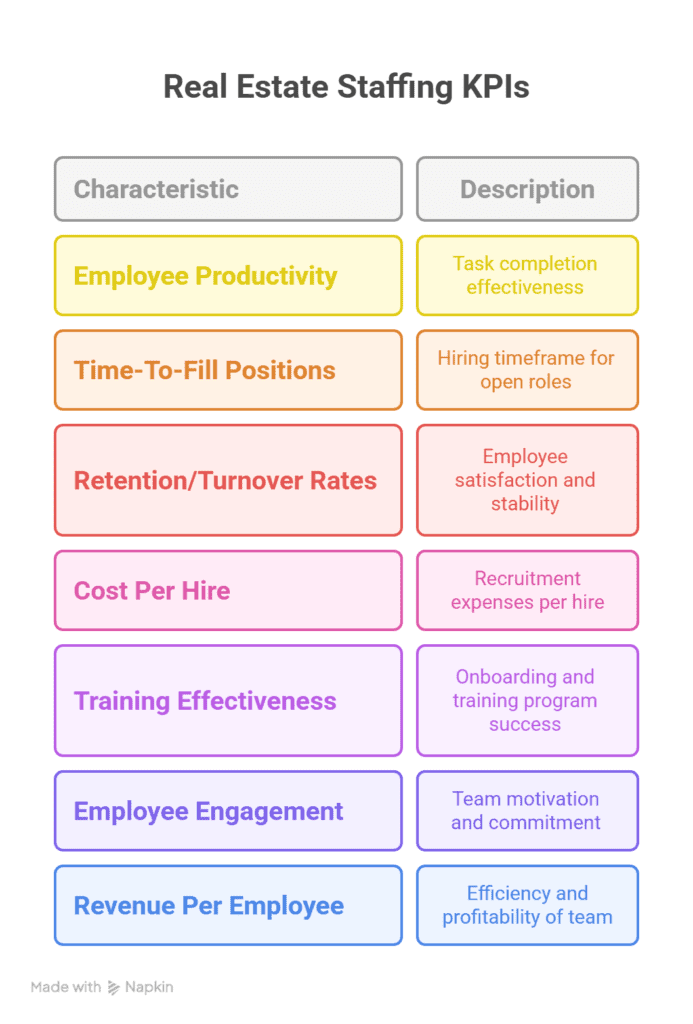
Employee Productivity Metrics
Employee productivity metrics evaluate how effectively your staff completes tasks. You can track the number of properties sold or leased per agent monthly, average response times to client inquiries, or completed administrative tasks weekly. High productivity often correlates with clear role definitions and streamlined workflows.
Time-To-Fill Positions
Time-to-fill measures the days it takes to hire for an open position. Shorter timeframes indicate efficient recruitment processes, while longer durations may signal bottlenecks like unclear job descriptions or limited candidate pools. For example, if filling a property manager role consistently exceeds 45 days, reviewing your sourcing channels could help.
Retention And Turnover Rates
Retention rates reflect employee satisfaction and workplace stability. Calculate this by dividing the number of employees who stay over a period by the total workforce at the start of that period. Conversely, turnover rates highlight departures within a timeframe. A high annual turnover rate—above 20%—may suggest issues such as inadequate training or misaligned expectations.
Cost Per Hire
Cost per hire quantifies recruitment expenses divided by hires made during a set period. Include advertising fees, recruiter salaries, and onboarding costs in this calculation. If hiring a leasing consultant averages $5,000 but delivers low ROI due to frequent turnovers, reassessing your investment in pre-hire assessments might be beneficial.
Training Effectiveness
Training effectiveness measures how well your onboarding and ongoing training programs prepare employees for their roles. Track metrics like time-to-productivity (how quickly new hires meet performance benchmarks) or post-training assessment scores. Ineffective training can lead to underperformance and higher turnover rates, making this a critical KPI.
Employee Engagement Levels
Employee engagement reflects how motivated and committed your team is to their work. Use surveys, feedback sessions, or tools like eNPS (Employee Net Promoter Score) to gauge engagement. Low engagement often correlates with poor morale, reduced productivity, and higher turnover, signaling the need for cultural or managerial improvements.
Revenue Per Employee
Revenue per employee measures the total revenue generated divided by the number of employees. This KPI highlights the overall efficiency and profitability of your team. A low figure may indicate overstaffing, inefficiencies, or underperforming employees, while a high figure suggests optimal resource utilization.
How to Measure ROI For Real Estate Staffing?
Tracking the return on investment (ROI) for real estate staffing ensures your hiring strategies contribute to profitability. By analyzing costs and outcomes, you can identify inefficiencies and optimize resource allocation.
Calculating ROI In Staffing Investments
To calculate ROI in staffing, compare the total cost of recruitment and employment with the revenue or value generated by those hires. Start by summing up expenses like salaries, benefits, training costs, and recruitment fees. Then measure the financial impact of employee contributions through metrics such as closed deals, property sales volume, or operational savings.
For example:
- Revenue Generated Per Employee: Divide total revenue by the number of employees to assess individual output.
- Cost-to-Revenue Ratio: Compare total staffing costs against overall revenue to evaluate efficiency.
- Time-to-Profitability: Track how long it takes new hires to generate enough value to cover their onboarding costs.
These calculations highlight whether your investments in staff are yielding measurable returns or require adjustments.
Tools To Track Staffing ROI Effectively
Use tools designed for workforce analytics to streamline tracking and analysis. Applicant tracking systems (ATS), human resources management software (HRMS), and customer relationship management (CRM) platforms integrate data from hiring processes, employee performance, and client interactions.
Examples include:
- ATS Platforms: Monitor time-to-fill vacancies and cost per hire using tools like Greenhouse or Workable.
- HRMS Solutions: Analyze retention rates and productivity metrics with software like BambooHR or ADP Workforce Now.
- CRM Systems: Measure team contributions to client acquisition or deal closures through Salesforce or HubSpot.
Leverage these technologies to collect actionable insights that align staffing decisions with business goals.
Best Practices For Improving Staffing ROI
Optimizing staffing ROI in real estate requires strategic actions that enhance efficiency and reduce costs. Focus on refining processes, developing talent, and leveraging technology to achieve measurable results.
Streamlining The Hiring Process
Simplify hiring by standardizing procedures and eliminating unnecessary steps. Use structured interviews and predefined evaluation criteria to ensure consistency. Implement applicant tracking systems (ATS) to manage applications efficiently and identify qualified candidates faster. Monitor time-to-fill metrics regularly to spot delays and address bottlenecks in the recruitment pipeline.
For example, if your average time-to-fill exceeds 30 days, analyze each stage of the process for inefficiencies. Reducing this metric improves productivity by minimizing project delays caused by vacant roles.
Investing In Employee Training And Development
Prioritize training programs that align with business goals. Offer role-specific skill development courses, leadership workshops, or certifications relevant to real estate operations. Track employee performance before and after training sessions using KPIs like task completion rates or client satisfaction scores.
Retention rates often improve when employees feel supported in their professional growth. If turnover is high—above 20% annually—evaluate whether current development opportunities meet staff expectations.
Leveraging Technology For Staffing Efficiency
Adopt tools that automate repetitive tasks and centralize data management. Use human resources management software (HRMS) for payroll processing, compliance tracking, and performance reviews. Integrate customer relationship management (CRM) platforms with HR systems to align staffing efforts with sales objectives.
For instance, integrating ATS with CRM helps track how new hires contribute to revenue generation over time. This connection provides insights into which recruitment strategies yield the highest ROI while supporting long-term workforce planning.
Partnering with a Remote Real Estate Staffing Agency
Collaborating with a remote real estate staffing agency allows you to delegate the entire recruitment process to experts. These real estate staffing agencies specialize in sourcing, screening, and onboarding top talent, saving you time and resources. By outsourcing recruitment, you can focus on strategic business goals while ensuring a steady pipeline of qualified professionals. This approach also reduces time-to-fill and improves hiring efficiency, ultimately boosting your staffing ROI.
Exploring the Latin America Talent Market
The Latin America talent market is an untapped resource for skilled professionals in real estate roles. With competitive rates, strong work ethics, and time zone alignment with North America, this region offers a strategic advantage for hiring virtual assistants, property managers, and administrative staff.
Expanding your search to Latin America not only diversifies your talent pool but also enhances collaboration and productivity, making it a cost-effective solution for scaling your team.
Challenges In Monitoring Staffing KPIs And ROI
Tracking staffing KPIs and ROI in real estate presents unique obstacles. You face issues like inconsistent data collection, balancing recruitment costs with quality hires, and aligning metrics with business goals.
Data Collection Hurdles
You often encounter fragmented systems that make gathering accurate data difficult. For example, applicant tracking systems (ATS) might not integrate seamlessly with HR management software (HRMS), leading to incomplete or duplicated records. Manual data entry increases errors, reducing the reliability of your metrics.
Inconsistent reporting formats across departments further complicate analysis. If one team tracks time-to-fill differently than another, comparing performance becomes nearly impossible. Without standardized processes, you struggle to identify trends or actionable insights.
Balancing Cost And Quality In Recruitment
Recruitment demands careful resource allocation. Hiring high-performing employees can be expensive when factoring in sourcing channels, interview processes, and onboarding programs. You risk overspending if these efforts don’t translate into measurable productivity gains.
On the other hand, cutting costs too aggressively may lead to lower-quality hires who underperform or leave quickly. High turnover rates increase long-term expenses by requiring repeated hiring cycles while disrupting project timelines and team stability.
Conclusion
This article highlights the importance of tracking key real estate staffing KPIs such as employee productivity, time-to-fill positions, retention rates, and cost per hire. It also emphasizes advanced best practices like partnering with remote staffing agencies and exploring the Latin America talent market to enhance recruitment efficiency and ROI. By leveraging technology, refining hiring processes, and investing in employee development, real estate businesses can optimize their staffing strategies to achieve long-term profitability and operational success.
If you’re looking to simplify your hiring process and access top-tier real estate talent from Latin America, Wow Remote Teams is your ultimate solution. Specializing in connecting businesses with skilled professionals, Wow Remote Teams helps you find, hire, and onboard exceptional talent quickly and efficiently. With a focus on cost-effectiveness and seamless collaboration, they ensure your team is equipped to thrive in a competitive market.
Ready to build your dream team? Book a call with Wow Remote Teams today and discover how they can help you scale your real estate business with top talent from Latin America!
Recommended Resources
➤ Best Countries in LATAM to Hire Real Estate Admin Talent
➤ What is a Property Management Recruitment Agency?
➤ Top Benefits of Hiring a Real Estate Recruitment Agency
➤ Top Real Estate Virtual Assistant Tools
➤ How Much Does It Cost to Hire a Remote Real Estate Pro?
➤ Tasks to Delegate to Real Estate Virtual Assistants
➤ Remote vs In-House Real Estate Staffing
➤ Strategies to Boost Productivity in Remote Real Estate Teams
➤ Skills to Look for in Remote Real Estate Professionals
Frequently Asked Questions
What are the key KPIs to track in real estate staffing?
Key KPIs include employee productivity, time-to-fill vacancies, turnover rates, retention rates, cost per hire, and employee satisfaction scores. These metrics help assess recruitment efficiency, workplace stability, and overall team performance.
Why is tracking ROI important in real estate staffing?
Tracking ROI ensures that hiring strategies contribute to profitability by comparing recruitment costs with revenue generated by employees. It helps optimize resource allocation and improve decision-making.
How can I calculate ROI for real estate staffing?
ROI can be calculated by dividing the revenue generated by hires by total recruitment and employment costs. Metrics like revenue per employee and cost-to-revenue ratio are useful for this analysis.
What tools can help monitor staffing KPIs and ROI?
Tools such as applicant tracking systems (ATS), human resources management software (HRMS), and customer relationship management (CRM) platforms streamline data collection and provide actionable insights.
How does high turnover impact a real estate business?
High turnover indicates potential issues with workplace culture or job satisfaction. It increases recruitment costs, disrupts operations, and affects team morale, ultimately reducing profitability.
What is “time-to-fill,” and why is it important?
Time-to-fill measures how quickly vacant positions are filled. A shorter time-to-fill improves operational efficiency by minimizing project delays caused by understaffing.
How can technology improve staffing processes in real estate?
Technology automates tasks like application management, centralizes data collection through integrated HR systems, and tracks the impact of new hires on business goals efficiently.
What are some best practices for improving staffing ROI?
Best practices include streamlining hiring processes with standardized procedures, investing in employee training to boost retention rates, leveraging ATS tools for efficient recruitment, and aligning strategies with business objectives.
What challenges arise when monitoring staffing KPIs in real estate?
Challenges include inconsistent data collection across departments, fragmented reporting systems hindering comparisons, balancing quality hires with budget constraints, and aligning metrics with broader business goals.
Why is employee training crucial for boosting retention rates?
Employee training enhances skills development while fostering job satisfaction. This reduces turnover rates over time and aligns workforce capabilities with long-term organizational objectives.