
In remote companies, hiring can’t rely on in-person impressions or spontaneous office chats. Every touchpoint must be intentional. That’s where a recruitment funnel becomes indispensable.
A recruitment funnel for remote teams is a structured, step-by-step hiring process designed to attract, assess, and onboard the right candidates efficiently—without the need for physical interaction.
Here’s how to build one:
- Awareness
- Application
- Screening
- Interview & Assessment
- Offer & Onboarding
TL;DR – Key Takeaways from the Recruitment Funnel Guide
1. A recruitment funnel is a structured hiring framework that guides candidates through awareness, application, screening, interview, and onboarding—ensuring consistent quality and speed across every role.
2. Each funnel stage should be measured using metrics like application completion rate, interview-to-offer ratio, and time-to-productivity to identify drop-offs and optimize performance.
3. Business owners can outsource the funnel to remote staffing agencies like Wow Remote Teams to access pre-vetted LATAM talent within 3–5 days—saving time and scaling with confidence.
Awareness: Get in Front of the Right Remote Candidates
The awareness stage in a remote recruitment funnel focuses on distribution, ensuring your job opening appears in the places where qualified remote professionals are already looking. This step affects application volume, relevance, and cost efficiency.
Common Tactics
1. Post on Remote-First Job Boards
Prioritize platforms built for distributed workforces. These attract candidates who are familiar with async communication, self-management, and timezone coordination.
Recommended platforms:
- We Work Remotely
- Remote OK
- Jobspresso
- Remotive
- AngelList Talent (for startups)
Each site serves a slightly different candidate profile. Match platform selection to the role. For example, Remote OK performs well for technical positions, while Remotive often yields strong candidates for support and operations.
2. Use Targeted Paid Ads on LinkedIn and Meta
Configure campaigns using filters such as:
- Job title
- Remote work interest
- Industry experience
- Timezone or region
This reduces noise and limits applications to professionals with relevant context and availability.
3. Build Role-Specific Landing Pages
Each job should have a dedicated, indexable URL that:
- Includes the job title in the H1 and metadata
- Describes responsibilities in plain terms
- Lists timezone expectations
- States the salary range or compensation policy
- Features a single, high-visibility CTA (e.g., “Apply Now”)
4. Add Visual and Written Proof of Remote Operations
Candidates assess the operational maturity of a remote company. Add:
- Short video clips from team members discussing the role
- Screenshots of async tools in use (e.g., Slack threads, Notion dashboards)
- Sample weekly plans or task formats used in the role
This reinforces credibility and supports better self-selection by applicants.
Why Doing This?
Remote job seekers often rely on trusted digital ecosystems and peer recommendations. Most evaluate opportunities asynchronously, using job boards, search engines, and niche communities. Placement in these environments increases exposure to qualified candidates without requiring additional recruiter outreach.
Pitfalls if Done Wrong
- Using generic job boards without tagging positions as remote results in misaligned applications.
- Leaving out timezone requirements leads to scheduling conflicts and higher drop-off rates during screening.
- Overcomplicating descriptions with jargon or broad language reduces clarity and discourages serious candidates.
Gains if Done Right
- Higher percentage of applicants with prior remote experience and the required availability
- Lower cost per qualified applicant due to accurate targeting
- Clearer employer perception among experienced remote professionals
Application: Capture the Right Information Without Creating Barriers
Once candidates become aware of the opportunity, the next objective is to collect qualified applications with minimal friction. This step requires structuring a lightweight, informative process that allows you to assess fit while respecting candidates’ time and context.
Candidates are often evaluating multiple roles simultaneously and applying across various time zones. A well-structured application flow signals operational competence, filters early for alignment, and improves downstream efficiency in screening and selection.
Recommended Tactics
1. Use Lightweight, Asynchronous Application Forms
Replace traditional multi-step ATS workflows with tools that allow for flexibility and ease of use:
- Forms: Use tools like Typeform or Jotform with conditional logic to adapt questions to candidate responses.
- Async video inputs: Platforms like VideoAsk allow candidates to record short responses to prompts (e.g., why they’re interested, how they manage async collaboration).
Keep initial forms short—no more than 5–7 required fields—and avoid asking for documents (e.g., portfolios or references) at this stage unless the role strictly depends on them.
2. Collect Operational Data Relevant to Remote Work
Add specific questions to capture technical and logistical fit:
- Timezone and preferred working hours
- Internet speed (include a speedtest link if necessary)
- Type of device used and work environment (home office, coworking space, etc.)
These filters are critical for roles where real-time availability or system reliability matters, such as customer-facing or deadline-sensitive marketing positions.
3. Provide a Realistic Job Preview (RJP)
On the same page or in the confirmation email after application, include a clear breakdown of:
- Core responsibilities (with specific tools and processes used)
- Communication cadence (e.g., weekly async updates, monthly live calls)
- Key performance metrics (e.g., for a paid ads specialist: CPL, ROAS, campaign velocity)
This ensures that candidates understand how performance will be measured and how work is actually executed.
4. Allow Candidates to Self-Select Out
The application form and job page should work as a dual filter—capturing qualified leads and filtering out poor matches. This is especially useful for remote marketing roles where misalignment on tools (e.g., HubSpot vs. Marketo), methodology (e.g., Agile vs. Kanban), or time expectations can lead to misfires later.
Why This Step Matters
An efficient, purpose-built application step reduces friction without compromising the quality of candidate data. In remote recruitment, speed and clarity directly impact who makes it to the funnel’s next stage. Candidates who apply to marketing roles, for example, often do so in batches—companies with clean, transparent application flows are more likely to convert top talent before competitors reach them.
At the same time, collecting structured inputs early (timezone, tech setup, async video) gives hiring managers more actionable signals and reduces dependency on subjective resume evaluations.
For example:
A marketing agency hiring for a remote SEO strategist role embedded a short async application form on their landing page, which asked for timezone, preferred daily working hours, and a one-minute video explaining how they’ve scaled organic traffic in past roles.
They received fewer applications, but 80% were aligned and interview-ready, allowing the team to cut total hiring time by half.
Pitfalls to Avoid
- Bundling everything upfront (resume, cover letter, portfolio, references) increases drop-off rates significantly, especially among experienced professionals who are already employed.
- Using complex or poorly optimized ATS systems creates a poor mobile experience and discourages applicants in emerging markets where device usage varies.
- Failing to communicate scope and expectations clearly (e.g., salary, deliverables, availability) results in mismatches that only surface during the interview process, wasting time for both parties.
Gains When Done Correctly
- Improved application quality due to early self-filtering and role clarity
- Higher completion rates, especially from mid-senior talent in marketing or design roles
- Faster decision-making based on structured, actionable applicant inputs
- Better segmentation of applicants for targeted follow-up (e.g., auto-assigning candidates by timezone or skill set)
Screening: Qualify for Role Fit, Communication, and Remote Readiness
After collecting applications, the screening phase determines which candidates advance based on real evidence—not assumptions. For remote teams, screening must validate technical alignment, communication ability, and readiness to work in a distributed environment.
This stage replaces subjective evaluations with structured signals that support faster and more accurate decisions.
Recommended Tactics
1. Automate Initial Filtering Based on Defined Criteria
Use applicant tracking systems (ATS) with customizable filters to automatically score or sort applications. Key filters for remote marketing roles include:
- Language fluency (especially for roles involving client-facing communication or content)
- Timezone alignment (for roles requiring overlap with U.S. hours)
- Minimum years of experience in specific platforms (e.g., Google Ads, HubSpot, Klaviyo)
- Submitted assets (e.g., a writing sample or campaign breakdown)
Platforms like Ashby, Lever, or BreezyHR support this level of filtering and can tag or assign applications to hiring managers accordingly.
2. Deploy Structured, Asynchronous Skill Assessments
Assign short, role-specific tasks that mirror actual job duties. For marketing roles, this might include:
- Writing a short ad copy sample with a given brief and target persona
- Reviewing a landing page and suggesting CRO improvements
- Interpreting ad performance data to identify underperforming segments
Tasks should be time-limited (20–30 minutes max) and designed to assess decision-making and attention to detail—not just knowledge.
3. Evaluate Behavioral Fit Through Targeted Prompts
Incorporate async video or form responses that address key soft skills. Example prompts:
- “Describe how you prioritize work in a remote environment.”
- “Tell us about a time you managed a deliverable without real-time support.”
- “What tools or methods do you use to track your own performance?”
These insights help assess independence, organization, and documentation habits—traits critical in distributed marketing teams.
4. Use Scoring Rubrics to Standardize Evaluations
For every task or response, define a scoring rubric. Criteria may include:
- Clarity and structure of communication
- Ability to follow a brief
- Analytical thinking
- Strategic alignment with business objectives
Assign numeric scores to reduce subjectivity and ensure consistency across reviewers.
Why This Step Matters
In remote hiring, strong self-management and clear communication are non-negotiable. Resumes provide limited insight into these attributes. Screening tasks allow you to test real-world skills and behaviors that directly correlate with success in distributed teams.
For example, a marketing agency running paid social campaigns often receives candidates who claim proficiency in Meta Ads. A structured screening task asking candidates to audit a campaign budget and write a performance summary immediately reveals who understands ROAS, scaling strategies, and client-facing presentation. This eliminates misalignment before the interview stage.
Pitfalls to Avoid
- Using generic or templated assessments that don’t reflect the role’s actual responsibilities leads to irrelevant scoring and false disqualification.
- Skipping behavioral and communication evaluation, especially for client-facing or strategy roles, results in poor collaboration down the line.
- Adding too many steps or long-form assessments early in the process increases candidate drop-off, especially among in-demand professionals.
Benefits of a Structured Screening Stage
- Improves efficiency by reducing time spent reviewing unqualified or misaligned applicants
- Increases confidence in decision-making using structured, repeatable criteria
- Reduces reliance on intuition or CV interpretations, which are especially unreliable in global hiring contexts
- Elevates candidate experience by demonstrating role clarity and process transparency
Interview & Assessment: Validate Skills, Communication, and Operational Fit
Once candidates pass the screening phase, the interview and assessment stage verifies how well they can function within the specific requirements of a remote team. This step should not rely solely on conversation—it must combine structured dialogue, scenario-based exercises, and cross-functional evaluation to measure both role fit and collaboration style.
In remote-first teams, especially in industries like real estate or property management where client communication, deadline management, and task ownership are essential, the focus must be on how candidates operate in distributed, asynchronous environments.
Recommended Tactics
1. Conduct Structured Interviews Using Score-Based Criteria
Replace informal conversations with guided interviews that use scorecards aligned to core competencies. For a property marketing role, these might include:
- Responsiveness in async communication
- Familiarity with real estate marketing tools (e.g., Canva, HubSpot, MLS listing platforms)
- Ability to manage multiple listings and deadlines independently
- Attention to compliance and documentation detail (e.g., disclosures, ad copy review)
Each interviewer should be assigned a category (e.g., communication, task management, domain knowledge) to ensure consistent and objective evaluation.
2. Use Scheduling Tools That Reflect Remote Availability
Automate timezone coordination using tools like Calendly or SavvyCal, configured to limit calls to overlap hours. This saves time for both sides and eliminates avoidable friction. For example, when hiring a leasing coordinator across LATAM for a U.S.-based property firm, aligning availability for weekday morning meetings is often a non-negotiable requirement.
3. Evaluate Remote-Specific Work Habits Through Behavioral Questions
Design prompts to uncover real working patterns. Examples:
- “Describe how you handle tasks that require follow-up without a direct manager checking in.”
- “Give an example of how you tracked your work progress in a distributed team.”
- “How do you escalate client issues in a remote environment when response time is critical?”
Responses should demonstrate self-management, clarity, and awareness of asynchronous limitations.
4. Include Job Simulations or Paired Sessions
Use scenario-based simulations that mirror actual responsibilities. For example:
- A marketing candidate might be asked to draft a property listing description, incorporating tone guidelines and key selling points.
- A remote assistant candidate may complete a mock tenant screening coordination task, including email drafting and CRM updates.
For mid-senior hires, pair sessions with a future colleague (e.g., a virtual walkthrough of how they manage tasks in your property management system) allow both sides to evaluate working style compatibility.
Why This Step Matters
Interviews are often misunderstood as a final gate, but in remote hiring they serve as operational simulations. Remote roles—especially those handling tasks across multiple locations and clients—require a predictable and self-directed working style.
Candidates who excel in structured interviews and job simulations are more likely to meet deadlines, communicate proactively, and contribute to client satisfaction without ongoing oversight.
Last year, a U.S.-based property management firm expanded operations into Texas and needed a remote marketing coordinator based in Latin America. After inconsistent results from resume-based hiring, they switched to structured interviews plus a job simulation: writing a listing summary from raw input and updating a basic tracking sheet.
Candidates who submitted complete, error-free results within 24 hours consistently outperformed others during onboarding. This format became a standard part of their hiring playbook.
Pitfalls to Avoid
- Overemphasizing culture fit without validating how the candidate documents work, follows remote processes, or handles ambiguity.
- Allowing unstructured interviews, where biases or vague impressions distort decision-making.
- Skipping simulation-based assessments, leading to surprises after hire when operational performance is below expectations.
Gains When Done Correctly
- Improved candidate predictability — interview outcomes correlate with actual work performance
- Better cross-team alignment — when multiple stakeholders use shared scorecards
- Reduced early-stage churn — candidates who understand expectations during simulation stages are more likely to remain engaged post-hire
- Stronger collaboration dynamics — especially when paired sessions surface mutual working preferences and friction points
Offer & Onboarding: Finalize the Hire and Accelerate Productivity
The final stage of the recruitment funnel—extending the offer and onboarding—determines whether your selected candidate converts into a high-performing team member. In remote environments, where first impressions are shaped by process rather than presence, this phase must be designed with precision.
For distributed teams in accounting and finance, where confidentiality, process control, and documentation standards are critical, onboarding is more than orientation—it’s operational risk management.
Recommended Tactics
1. Extend Offers with Full Transparency
- Provide a written offer letter that includes:
- Role title and reporting structure
- Start date and working hours (including timezone overlap)
- Monthly or hourly compensation (gross vs. net if applicable)
- Equipment, software access, and any recurring stipends (e.g., internet, home office)
- Use tools like DocuSign or PandaDoc for secure, trackable digital signatures.
- Avoid verbal-only offers or vague descriptions. Detail is especially important for international hires who may require documentation for payment processing or contract validation.
2. Send Structured Pre-Onboarding Documentation
Before the start date, send a digital onboarding kit containing:
- Org chart with relevant contacts
- Tech stack setup guide (with login credentials for tools like QuickBooks, Xero, Slack, etc.)
- Process documentation for tasks the employee will own within their first two weeks
- Compliance and security training links if the role involves handling sensitive financial data
This allows the employee to begin orientation asynchronously, reducing first-day confusion and dependency on real-time interactions.
3. Combine Asynchronous and Live Onboarding Activities
Design a hybrid onboarding experience over the first 1–2 weeks:
- Day 1: Slack introduction thread and welcome message from the team
- Day 2–3: Self-paced review of SOPs and walkthrough videos (hosted in Notion or Google Drive)
- Day 4+: One-on-one check-ins with team members or managers, scheduled in advance
This approach accommodates timezone differences and prevents new hires from being overloaded or under-supported.
4. Assign a Ramp Plan With Clear Milestones
For example, an accounting assistant might have the following 2-week plan:
- Week 1: Learn workflow tools, complete test entries in accounting software, and review internal documentation standards
- Week 2: Shadow a senior bookkeeper on a client file, then take ownership of 1–2 accounts under supervision
This reduces ambiguity and helps the employee build early momentum.
Why This Step Matters
Unlike on-site teams, remote employees don’t learn by observing others or absorbing office routines. Their engagement and ramp-up speed depend entirely on how well the company structures their onboarding experience.
In a remote finance firm, for instance, assigning access to accounting systems, two-factor authentication setups, and password managers can take 2–3 days if not coordinated. Similarly, an unclear billing workflow or unassigned responsibility matrix can delay revenue operations and affect client satisfaction.
Recently, a remote bookkeeping agency based in the U.S. scaled from 6 to 20 employees across LATAM. Early hires lacked onboarding structure, leading to slow adoption of internal systems like Gusto, Bill.com, and ClickUp.
After implementing a standardized onboarding protocol—including a 3-day async learning module and a checklist-based access process—the average time to full task ownership dropped from 18 to 8 days.
Pitfalls to Avoid
- Delaying access to essential systems (e.g., accounting platforms, file drives, payroll tools) undermines productivity and damages first-week momentum
- Failing to assign onboarding ownership leads to miscommunication and inconsistent ramp-up experiences
- Overloading new hires with simultaneous meetings, platforms, and documents creates cognitive fatigue and confusion
Gains When Done Correctly
- Faster integration and output, particularly in task-heavy roles such as bookkeeping, payroll, or invoicing coordination
- Higher first-90-day retention, especially for remote hires who often judge fit based on clarity and responsiveness
- Consistent delivery standards, as new hires align quickly with internal processes and documentation practices
- Reduced risk of compliance errors, when onboarding includes data handling protocols and platform training from day one
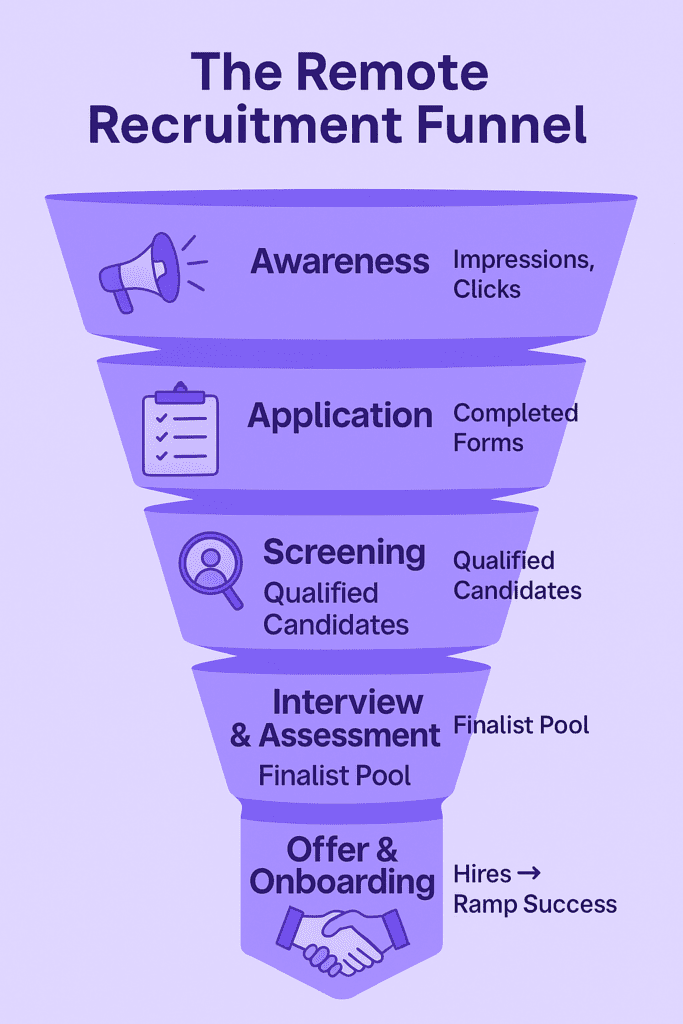
What Is a Recruitment Funnel? (Definition + Visual Breakdown)
A recruitment funnel is a structured, multi-stage process used to attract, evaluate, and convert job candidates into hired employees. It mirrors the concept of a sales funnel—starting wide to generate awareness and narrowing through qualification and interviews until an offer is made and accepted.
In remote hiring, the recruitment funnel helps in maintaining consistency, evaluating candidates across time zones, and minimizing subjectivity by applying structured filters at each stage.
Core Stages of a Recruitment Funnel
Each stage has a specific objective, input, and metric.
Here’s a breakdown:
| Funnel Stage | Objective | Typical Activities | Key Metrics |
|---|---|---|---|
| Awareness | Drive qualified traffic to the job opportunity | Job board ads, landing pages, email outreach | Views, CTR, source quality |
| Application | Capture essential candidate data | Form submissions, async video, resume collection | Application rate, completion rate |
| Screening | Evaluate initial fit based on predefined filters | Skills tests, eligibility checks, automated scoring | % Qualified, time to screen |
| Interview & Assessment | Assess role-specific capabilities and behaviors | Structured interviews, simulations, team alignment checks | Interview-to-offer ratio, candidate NPS |
| Offer & Onboarding | Finalize the hire and integrate into the team | Offer letter, preboarding kit, system setup, 30-day ramp plan | Offer acceptance rate, time-to-productivity |
Why It Matters
Without a funnel, remote hiring becomes reactive and inconsistent. A well-defined recruitment funnel enables distributed teams to:
- Reduce hiring time by eliminating unqualified candidates early
- Collect comparable data to improve hiring decisions
- Align hiring processes across departments and geographies
- Improve candidate experience through structured, transparent progression
This framework not only scales hiring efforts but also improves retention by ensuring the right candidates move through a predictable, repeatable system.
Recruitment Funnel Metrics: How to Measure Performance at Each Stage
To operate a high-performing recruitment funnel, execution alone isn’t enough. Without consistent tracking of funnel metrics, it becomes difficult to identify inefficiencies, forecast hiring timelines, or compare sourcing channels. Each stage of the recruitment funnel should be tied to measurable data points that reflect conversion health, process speed, and candidate quality.
Let’s explain the essential recruitment funnel KPIs and how to use them to diagnose issues and improve performance.
Key Metrics by Funnel
| Funnel Stage | Primary Metric | What It Measures | Why It Matters |
|---|---|---|---|
| Awareness | Impressions-to-Clicks (CTR) | % of people who engage with your job post or ad | Evaluates job post targeting and copy effectiveness |
| Source of Hire | Top-converting job boards or channels | Allows resource allocation to the most efficient platforms | |
| Application | Application Completion Rate | % of candidates who start and finish the application process | Indicates friction or drop-off in application UX |
| Application-to-Screened Ratio | % of applicants who pass initial filters | Helps refine job ad clarity and screening criteria | |
| Screening | Screened-to-Interview Ratio | % of screened candidates that qualify for interviews | Reveals if screening is too strict or too loose |
| Average Screening Time | Hours/days between application and decision to proceed | Indicates internal review speed and bottlenecks | |
| Interview & Assessment | Interview-to-Offer Ratio | % of interviewed candidates who receive an offer | Measures candidate quality and interview calibration |
| Candidate Experience Score | Survey score from interviewees | Indicates employer brand and experience quality | |
| Offer & Onboarding | Offer Acceptance Rate | % of offers that are accepted | Identifies compensation misalignment or late-stage candidate churn |
| Time-to-Productivity | Days from hire to task independence | Tracks onboarding effectiveness and alignment with role expectations |
Diagnostic Use Cases
These KPIs not only provide visibility—they help isolate friction points. Consider the following scenarios:
- High awareness but low applications?
Likely issues: poor job description clarity, lengthy forms, or weak call-to-action. - Many applications but low interview rates?
Likely issues: irrelevant traffic, misaligned targeting, or vague role requirements. - Strong interviews but low offer acceptance?
Likely issues: compensation gaps, unclear expectations during the process, or slow response times. - High offer acceptance but poor ramp-up?
Likely issues: onboarding gaps, inadequate documentation, or tool access delays.
Benchmarks to Guide Optimization
While benchmarks vary by industry and role, here are general reference points for remote-first recruitment funnels:
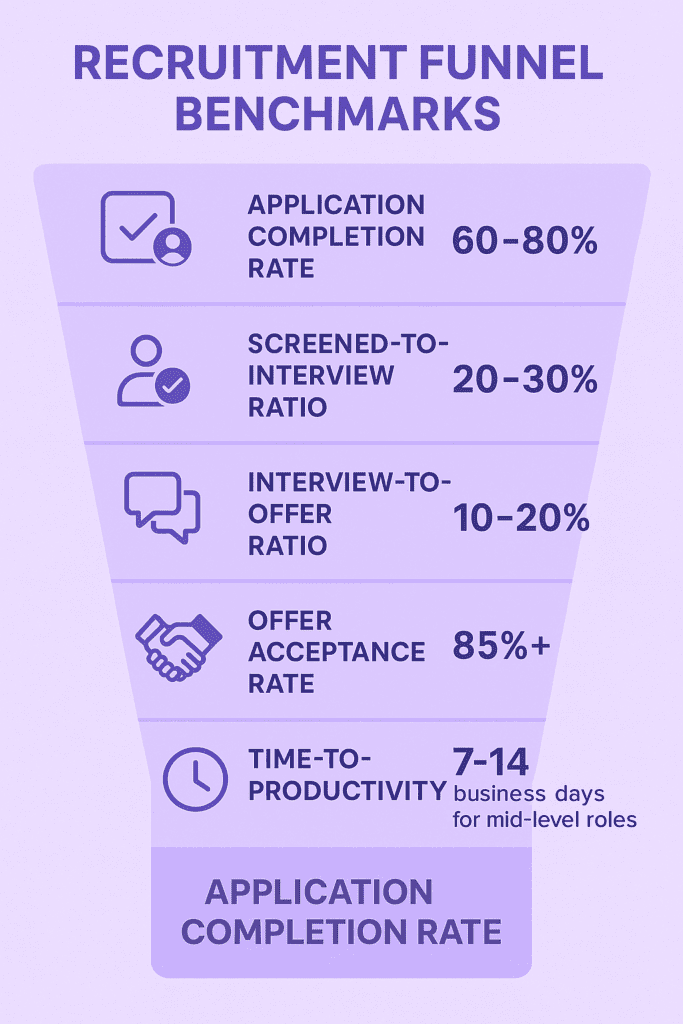
Without consistent metrics, recruitment decisions default to guesswork. By tracking KPIs per stage and comparing funnel velocity across roles or channels, teams can improve hiring speed, lower cost-per-hire, and build predictable talent pipelines—especially critical in remote environments where asynchronous decisions depend heavily on process quality.
Let me know if you want to visualize this as a dashboard wireframe or embed it as a downloadable funnel performance template.
Recruitment Funnel vs. Sales Funnel: Operational Parallels for Growth Teams
For founders, growth leads, and agency operators accustomed to managing sales pipelines, understanding the recruitment funnel becomes easier when framed through operational parallels.
Both funnels follow a staged, conversion-based framework, where the goal is to move qualified targets through a structured process toward a final action, whether it’s a signed deal or a signed offer letter.
When treated with the same rigor as client acquisition, recruitment becomes predictable, measurable, and aligned with business velocity.
Structural Comparison: Stage by Stage
| Recruitment Funnel Stage | Sales Funnel Equivalent | Shared Objective |
|---|---|---|
| Awareness | Lead Generation | Attract attention from qualified prospects |
| Application | Initial Contact / Inquiry | Capture essential data and initiate engagement |
| Screening | Qualification / Discovery | Validate fit through predefined criteria |
| Interview & Assessment | Proposal / Evaluation | Present value, address objections, assess match |
| Offer & Onboarding | Close / Onboarding | Finalize commitment and transition into delivery |
This alignment shows that recruitment is not an isolated HR function—it’s a conversion-driven system that mirrors the logic of revenue operations.
Metric Parallels: Recruitment KPIs as Pipeline Indicators
| Recruitment KPI | Sales KPI Equivalent | Purpose |
|---|---|---|
| Application-to-Screen Rate | Lead-to-MQL Conversion Rate | Measures top-of-funnel targeting efficiency |
| Interview-to-Offer Ratio | Proposal-to-Close Ratio | Indicates mid-funnel match and communication |
| Offer Acceptance Rate | Deal Close Rate | Reflects alignment in value, timing, and fit |
| Time-to-Hire | Sales Cycle Length | Impacts forecasting and resource planning |
| Time-to-Productivity | Customer Time-to-Value (TTV) | Measures onboarding and early-stage ROI |
Why the Parallel Matters for Scaling Teams
Recruitment pipelines can be systematized with the same tools and thinking used in sales operations. For example:
- CRM-like tracking: Treat applicants as pipeline entities in an ATS or recruitment CRM.
- Nurture automation: Use email sequences for passive candidates the same way you would for leads not yet ready to buy.
- Segmented sourcing: Prioritize candidate pools based on conversion rates, much like channel attribution in marketing.
When business owners apply revenue operations logic to hiring, they reduce dependency on reactive recruiting and gain visibility into talent acquisition velocity—critical during growth phases.
Closing Insight
If you’re already running a predictable sales process, you have the playbook to build a recruitment engine. Hiring, like sales, is a volume and conversion game—but with talent instead of contracts. The same principles of segmentation, engagement, qualification, and conversion apply.
What changes is the context, not the system.
How to Audit and Optimize an Underperforming Recruitment Funnel
An underperforming recruitment funnel doesn’t always fail at the final step—most issues begin upstream and compound through each stage. Whether you’re facing low applicant quality, stalled interviews, or offer rejections, the solution requires a structured audit to locate friction points, and targeted optimization to improve performance.
This guide walks through a practical, stage-by-stage approach to troubleshooting and upgrading a recruitment funnel that isn’t converting.
Step 1: Benchmark Funnel Performance with Baseline Metrics
Before making adjustments, collect current data across each funnel stage.
Focus on these five KPIs:
| Stage | Primary Metric |
|---|---|
| Awareness | Impressions-to-Click Rate |
| Application | Completion Rate |
| Screening | Qualified Candidate % |
| Interview & Assessment | Interview-to-Offer Ratio |
| Offer & Onboarding | Offer Acceptance Rate, Time-to-Productivity |
Use ATS or CRM data, and if necessary, extract reports manually into a spreadsheet to visualize drop-off points. Benchmark against funnel averages or internal historical data.
Tip: A drop of over 30% between stages without a corresponding quality gain usually indicates a process breakdown.
Step 2: Identify Drop-Off Points and Diagnose Root Causes
For each major stage, assess specific failure points:
Awareness Stage Issues
- Symptoms: Low reach, high cost-per-click, irrelevant applications
- Audit:
- Are you using the right sourcing platforms for the role type?
- Is the job title aligned with keyword search behavior (e.g., “Virtual Sales Assistant” vs. “Remote SDR”)?
- Are your job ads or landing pages optimized for mobile?
Application Stage Issues
- Symptoms: High traffic, low completion rates
- Audit:
- Is the application form too long or technically broken?
- Is there friction for mobile users or international applicants (e.g., address fields, document upload limits)?
- Are you failing to set expectations (e.g., salary, timezone, workload)?
Screening Stage Issues
- Symptoms: Too many unqualified applicants or too few making it to interviews
- Audit:
- Are screening tasks aligned with actual job responsibilities?
- Are filters in your ATS misconfigured or overly strict?
- Are you reviewing async responses and skill assessments with a scoring rubric?
Interview & Assessment Stage Issues
- Symptoms: High no-show rates, poor performance in interviews, low progression
- Audit:
- Are interviews scheduled too far out, leading to drop-off?
- Is there alignment among interviewers on what qualifies as “ready”?
- Are candidates unclear about what to expect in simulations or assessments?
Offer & Onboarding Stage Issues
- Symptoms: Offers declined, delayed start dates, slow onboarding ramp
- Audit:
- Are your offers competitive and clearly communicated?
- Is your onboarding checklist incomplete or disorganized?
- Are international candidates receiving proper documentation or payment setup?
Step 3: Implement Targeted Optimization Actions
Once failure points are identified, deploy precise changes rather than rebuilding the funnel entirely.
Recommendations by stage:
| Stage | Optimizations |
|---|---|
| Awareness | A/B test job titles, use role-specific platforms, improve ad visuals and copy |
| Application | Reduce form fields, integrate async video, auto-save progress |
| Screening | Replace resume screening with task-based filters, clarify role expectations |
| Interview & Assessment | Use standardized scorecards, reduce time between stages, align on criteria |
| Offer & Onboarding | Include video summaries in offer letters, introduce pre-boarding SOPs |
Step 4: Create a Funnel Performance Dashboard
Use tools like Google Sheets + Looker Studio or built-in ATS dashboards to monitor:
- Stage-by-stage conversion rates
- Days in stage
- Source quality by platform
- Funnel velocity (average time from application to offer)
Set quarterly targets and run a post-hire audit after each recruitment cycle to close the loop between funnel behavior and actual employee performance.
Step 5: Build Continuous Optimization into Hiring Ops
Optimization is not a one-time fix. Assign ownership over funnel analytics (often a hiring manager or operations lead) and integrate monthly funnel reviews into your hiring retrospectives.
Include:
- Candidate feedback surveys (drop-off reasons)
- Interviewer calibration sessions
- Quarterly sourcing channel ROI reviews
This allows you to iterate your funnel with the same discipline you apply to sales or client acquisition processes.
Outsourcing the Recruitment Funnel Through a Remote Staffing Agency
Building and managing a high-performing recruitment funnel takes time, infrastructure, and hands-on oversight—resources that many founders and operational teams simply don’t have. In fast-paced environments where speed to hire impacts revenue, outsourcing the recruitment funnel to a specialized remote staffing agency is often the most strategic move.
Partnering with a firm that already has systems, talent pipelines, and localized knowledge, like Wow Remote Teams, allows businesses to bypass the overhead of building their own internal recruiting engine and still access top-tier candidates in a matter of days.
Why Outsource the Funnel?
Outsourcing doesn’t mean giving up control. It means transferring operational tasks—sourcing, screening, shortlisting—to a specialized partner so your internal team can focus solely on final-stage decision-making and onboarding.
Here’s why this model works:
| Challenge | Agency Solution |
|---|---|
| Lack of internal recruiters or HR infrastructure | Dedicated sourcing specialists + pre-built funnel systems |
| Delays in reaching qualified candidates | Active talent pools across LATAM, updated weekly |
| Limited access to global talent | Regionally focused outreach, localized job boards, and bilingual candidate support |
| Inconsistent screening and qualification standards | Structured assessments, standardized evaluations, and scorecards |
| Low interview turnout or poor applicant quality | Pre-vetted shortlists with high availability and timezone alignment |
What the Partnership Looks Like
With Wow Remote Teams, you’re not buying resumes—you’re gaining a streamlined, done-for-you recruiting engine optimized for remote hiring.
How It Works:
- Submit your hiring need (e.g., marketing coordinator, SDR, account manager).
- Receive pre-qualified candidates in 3–5 business days, each aligned by role, timezone, and work setup.
- Interview only top matches—all have passed screening assessments, availability checks, and language tests.
- Hire with confidence knowing each candidate has been sourced for performance, not just credentials.
Results That Drive Business Growth
The goal is not just to fill roles, but to do it faster, with better alignment, and lower risk. By outsourcing your recruitment funnel:
- Time-to-interview shrinks from weeks to days
- Internal workload drops by up to 80%, especially in sourcing and screening
- Hiring consistency improves, with candidates evaluated using standardized remote-readiness criteria
- Retention increases, as vetting includes soft skills, autonomy, and async communication fit
Client Example: A U.S.-based marketing agency needed to hire two bilingual account coordinators within a 10-day window. With Wow Remote Teams, they received 6 pre-qualified profiles in 4 days, interviewed 3, and hired both within the week—without posting a single job ad or reviewing unqualified applications.
Why LATAM Talent?
Hiring from Latin America offers a powerful blend of:
- Timezone compatibility with U.S. and Canada-based teams
- Highly skilled professionals trained in digital marketing, sales ops, design, and finance
- Cultural alignment with North American business norms
- Cost efficiency without sacrificing candidate quality
Wow Remote Teams specializes in sourcing LATAM talent for marketing, sales, admin, and finance roles—ensuring smooth communication, fast ramp-up, and long-term success.
Final Thought
Hiring is too important to leave to chance—or to an overworked in-house team without the tools to scale it. When you outsource the recruitment funnel to a remote staffing partner like Wow Remote Teams, you’re not just filling roles. You’re buying time, structure, and hiring confidence.
Start interviewing pre-vetted remote professionals in 3–5 days.
Let’s build your remote team—without the friction.
👉 [Book a free strategy session] to get started.