
Hiring your first remote marketing team marks a fundamental shift in how your business grows. It’s not about outsourcing tasks or saving on office space. It’s about designing a performance system, one where marketing becomes a revenue engine instead of a cost center. The problem most founders face isn’t that they can’t find talent. It’s that they’re looking for people without understanding what those people are meant to achieve.
That’s where this guide begins.
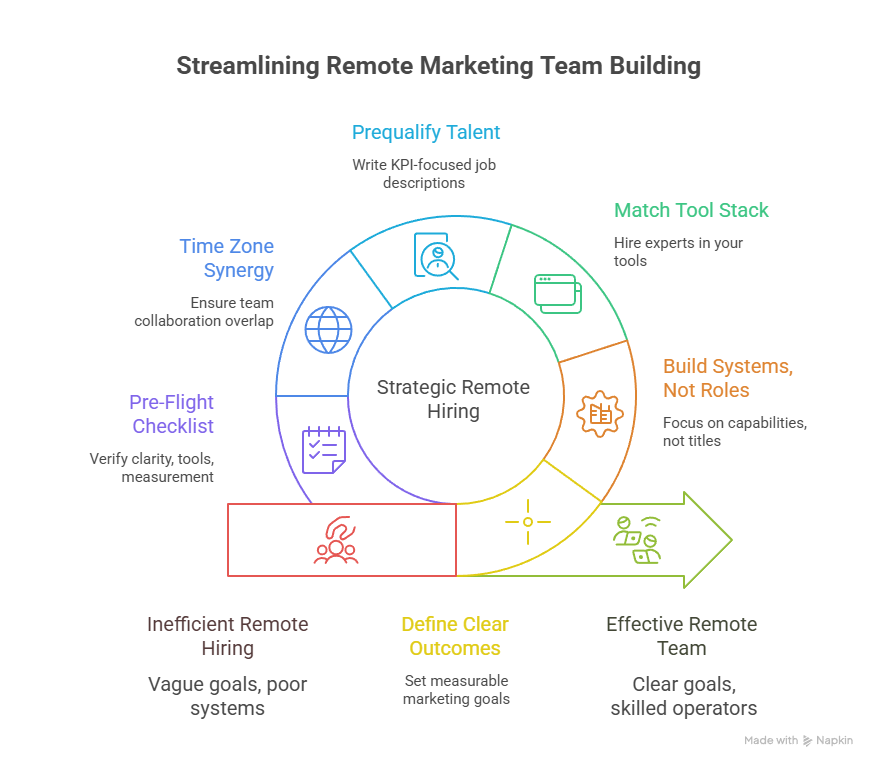
Define Marketing Success Before You Hire Anyone
Before you hire a single marketer, you need to know the precise outcomes you expect from your marketing engine in the next quarter, half-year, and full year.
Not vague objectives like “brand awareness” or “more traffic,” but real, measurable goals. Can you articulate exactly how many leads you need to hit revenue targets? Do you know what customer acquisition cost you can tolerate before you start bleeding margin?
These numbers are not optional. They define who you hire, how you manage them, and what success even means.
Stop Hiring Roles — Start Building Systems
Too many teams are built around roles rather than results. A business starts with the idea that it “needs marketing,” so it posts a job for a generalist or brings in a freelancer with decent credentials.
Three months later, KPIs haven’t moved, and everyone’s frustrated. The issue wasn’t the person — it was the process. A high-functioning marketing team isn’t a list of job titles. It’s a set of tightly defined capabilities deployed in service of clear business goals.
Let’s take an example. Suppose your primary objective is to reduce your customer acquisition cost by 30% within the next 90 days.
That outcome requires specific skills: someone who can audit and rebuild your paid media funnel, someone who understands retargeting logic and landing page optimization, and someone who can produce high-converting creative.
That might be one person or three, but either way, the roles emerge from the mission — not the other way around.
Match Hires to Your Existing Tool Stack
The next layer is technical compatibility. Every marketing function runs on a stack. If you use HubSpot as your CRM, GoHighLevel for funnel automation, and WordPress for content delivery, those tools become constraints and leverage points.
Hire someone who doesn’t know them, and you’re buying a six-week learning curve. Hire someone fluent in them, and you’ve added a new operator to your system.
This is where remote hiring can either scale you or sink you. The talent pool is broader, but so is the variance. It’s easy to bring on someone who sounds smart but can’t execute. That’s why system design comes first. You should be able to sketch out your marketing engine on a whiteboard: what channels feed it, what tools run it, what numbers define its success, and what breakpoints exist that could stall growth. Then — and only then — do you write a job description.
Write Job Descriptions That Prequalify Talent
And that job description should read more like a brief from a growth consultant than a HR template.
Don’t talk about soft skills and team fit. Talk about numbers. Explain the KPIs this person will own. Show them the dashboards they’ll be working from. Clarify the tools they need to master from day one. The goal is to attract the right candidates— the operators who see your ad and think, “This is exactly what I do.”
Build Around Time Zone Synergy, Not Just Skills
Of course, assembling a team is not just about skills. It’s about coordination.
And when you’re hiring remotely, time zones aren’t an afterthought. They’re infrastructure. A performance marketer in Argentina, a writer in Warsaw, and a strategist in Sydney might all be brilliant individually. But if they can’t collaborate synchronously at least part of the day, you’ve created a coordination tax that will drag every project down.
A good rule of thumb is to keep your team within a four-hour overlap window. If your core leadership operates on Eastern Standard Time, look to Latin America and Western Europe for talent. That way, you maintain operational speed without requiring anyone to work in the middle of the night.
Remote work gives you access to the world — but you still need a working rhythm. Without it, even the best hires will underdeliver.
The Remote Hiring Pre-Flight Checklist
Finally, before you post a job or contact a single candidate, ask yourself three hard questions:
- Do I know exactly what this person needs to deliver, and by when?
- Do I have the tools, workflows, and support systems in place to enable them to s쳮d?
- Can I measure their performance objectively within the first 30 days?
If the answer to any of those questions is “no,” pause. Fix the system first. Clarity is not a luxury in remote hiring — it’s the only thing keeping your team from spinning in circles.
Once you’ve built that clarity, you’re ready to move to the next stage: understanding exactly who you need to hire, why, and how to make each hire count.
Role-by-Role Blueprint for Building a Remote Marketing Team
Start With the Core: Strategy, Performance, and Execution
You don’t need to hire ten people to build an effective remote marketing team. But you do need the right three to five people who cover the most strategic bases: demand generation, content-driven acquisition, conversion, and measurement.
If you’re hiring your first remote marketing team, these are the foundational roles.
The Growth Strategist: Your Marketing Team’s Architect
If you’re not a marketer yourself, your first hire should be someone who can build your marketing roadmap. This person is part strategist, part operator. They know how to audit funnels, diagnose where growth is blocked, and design campaigns that convert.
Look for candidates with experience across multiple channels and a proven record of scaling startups. Fractional CMOs or senior growth leads with startup backgrounds are a smart move if you can’t afford full-time.
Your outcome isn’t “having a strategist.” It’s clarity — a mapped marketing plan with goals, timelines, and a breakdown of roles you’ll need to execute.
The Paid Media Operator: Turn Dollars Into Data
If your customer acquisition depends on paid traffic, you need someone who thinks in terms of return on ad spend (ROAS), not impressions. This person owns Meta Ads, Google Ads, and possibly LinkedIn or TikTok, depending on your audience. They should be able to:
- Audit existing campaigns and show where you’re wasting spend
- Launch tests quickly, and iterate based on performance
- Understand pixel tracking, funnel drop-offs, and bid strategies
Don’t hire an agency for this at the start. You want one in-house Paid Ads Specialist, even part-time, who owns the learning curve of your product and audience.
The SEO + Content Lead: Build Organic Equity
This role is non-negotiable if your product has search demand. The right SEO hire will think beyond keywords. They’ll build topic clusters, manage content briefs, optimize for user intent, and collaborate with writers and designers to execute. SEO without strategy is a waste. Strategy without execution is dead weight.
They must understand tools like Ahrefs, Surfer SEO, and Google Search Console. Bonus if they can write. But at minimum, they should be able to guide writers through content frameworks that drive both traffic and conversions.
The Funnel Technician: Own Automation and CRM
Once you have traffic, you need conversion infrastructure. This is your marketing operations lead — someone fluent in HubSpot, ActiveCampaign, or GoHighLevel. They set up workflows, build email automations, handle lead scoring, and keep your CRM structured.
Without this person, you’ll leak leads. With them, you’ll convert passive traffic into an active pipeline.
The Conversion Copywriter: Message Drives Revenue
Good copy is a force multiplier. If you’re serious about direct-response performance — from landing pages to email flows to ad copy — the copywriter pays for themselves. You don’t need a novelist. You need someone who understands buyer psychology, writes for action, and knows how to test variants.
Whether full-time or freelance, this hire needs to collaborate across the team. They’re the connective tissue between strategy, product, and performance.
Where and How to Hire Top Remote Marketing Talent
Prioritize Time Zone Compatibility and Talent Density
When hiring remote marketers, time zone overlap is as important as skill. For North America, Latin America is ideal. For UK and EU-based companies, Eastern Europe consistently produces top-tier technical and strategic marketers at competitive rates. You’re looking for the sweet spot between cost, collaboration speed, and proven marketing capability.
The Best Platforms to Hire Remote Marketers
- WowRemoteTeams.com – Specializes in placing nearshore marketing talent. Pre-vetted, battle-tested, and ready to integrate.
- LinkedIn – Use Sales Navigator to filter by role, geography, and “open to work.” Connect directly with operators, not just agencies.
- Upwork – Still one of the best platforms for shortlisting freelancers, especially if you filter by 90%+ success rate and $10k+ earned.
- Facebook Groups – Communities like “Remote Marketers Worldwide” and “Online Geniuses” are active with job posts and warm referrals.
- GrowthMentor / MarketerHire – Ideal for fractional growth leads and short-term specialists. Pre-vetted, but premium rates.
Build a Hiring Funnel That Filters for Competence, Not Talk
Posting a job is easy. Filtering for execution is not. Here’s a proven funnel to vet remote marketers effectively:
- Outcome-Oriented Job Post – State exactly what they’ll be responsible for (e.g. “Reduce CAC to <$60 in 90 days using Meta and Google Ads”).
- Qualifying Form – Use Typeform or Google Forms to ask: “Share a campaign you built, what the objective was, and what the result was.” Add logic jumps to weed out fluff.
- Short Skills Challenge – One task. No more than 60 minutes. Examples:
- Create a 3-ad variant set for a cold traffic funnel
- Draft a 1-page topical cluster for an SEO campaign
- Write a 7-email onboarding flow for new leads
- Async Video Round – Ask for a Loom or Tella video where they explain how they’ve tackled a challenge relevant to your goals.
- Live Interview – Case-based. Not generic. “Here’s our funnel. Our CPL is $80. What would you do in Week 1?”
You’re not hiring a personality. You’re hiring outcomes. Treat your hiring funnel like a conversion funnel — optimized to filter for fit, speed, and real capability.
How to Manage a Remote Marketing Team that Performs Like an In-House Growth Org
Hiring is only half the equation. Managing remote teams requires more than Slack threads and task boards — it demands systems of accountability that are ruthless about outcomes and resilient to distance. You’re not building a distributed team. You’re engineering a distributed performance engine.
Build a Performance Operating System — Not a Project Queue
Remote teams don’t need project managers. They need operating systems. This means creating a repeatable rhythm of work that turns strategy into measurable action.
- Weekly cycles tied to real KPIs — not “activity logs.”
- Single source of truth (ClickUp, Notion, Linear) that contains priorities, owners, timelines, and metrics.
- Cross-role visibility so your SEO knows what Paid is doing, your writer knows what’s converting, and your strategist sees everything.
A remote marketing team should operate like a growth desk — aligned by metrics, responsive to data, and constantly iterating.
Use Time-Zone Leverage to Create an Asynchronous Feedback Loop
You don’t want 5 people on 5 different Zoom calls. You want a workflow where strategy moves forward while you sleep. This means:
- Async briefings using Loom, Notion, and recorded SOPs.
- Scheduled reviews (e.g. Wednesday performance checkpoint, Friday delivery audit).
- Clear turnaround standards — every deliverable has a 24- or 48-hour response rule.
The goal isn’t to create freedom. The goal is to eliminate latency. Async is only powerful if your team is trained to use it with urgency and discipline.
Make KPIs the Default Language of Communication
Remote work thrives when no one can hide behind noise. Every marketer on your team should report by metric, not by task.
Example: “Launched 3 campaigns” means nothing. But “reduced CPL by 21% this week through creative variant B” means everything.
Institute weekly reporting that answers 3 things:
- What did I ship that impacts the metric I own?
- What moved? (Show data)
- What’s blocked, and who can unblock it?
If they can’t answer that, they’re not managing their own performance — and you’ll be stuck doing it for them.
Set Quarterly OKRs With Role-Specific KPIs
Treat your remote marketing team like a profit center. That means everyone operates with a 90-day growth objective mapped to the company’s revenue goals.
Sample OKR for Paid Media Lead:
- Objective: Acquire 1,000 qualified leads below $60 CAC
- KR1: Launch 10 new ad sets with >2.5% CTR
- KR2: Achieve a 20% lower CPL vs. Q2 benchmark
- KR3: Reduce ad creative fatigue by rotating assets biweekly
Remote doesn’t mean informal. It means structured autonomy. You set the scoreboard. They move the numbers.
Automate Accountability — So You Can Scale
Don’t build a system that needs your constant presence. Build one where underperformance is self-evident.
- Use automated dashboards (Looker Studio, Databox, or built-in GA4/Meta dashboards) to surface core KPIs.
- Create red flags for underperformance (e.g. “CPL above $80 triggers an alert and meeting”).
- Define review cadences — monthly retros, quarterly OKR audits.
If someone underperforms, the system should notice — not you.
Pay for Results, Not Proximity
You’re not buying time. You’re buying movement. Align compensation accordingly:
- Base + performance tiers tied to owned KPIs
- Quarterly bonuses for hitting growth milestones
- Equity or revenue share for senior team members who can operate unsupervised
This turns your remote team into stakeholders — not just workers.
When It Breaks — How to Diagnose and Fix a Failing Remote Marketing Team
Even with the right hires, remote marketing teams can fail. And when they do, it’s rarely because of a single weak link. It’s because your system allowed failure to compound. If performance is flatlining — leads not growing, CAC creeping up, deliverables slipping — you need to diagnose fast, act faster.
This is the high-performance triage framework.
1. Don’t Ask “Who’s Failing” — Ask “Where Is the System Leaking?”
Performance problems almost always masquerade as people problems. But the real question is: Where is the process breaking down?
- Is the strategist unclear on revenue goals?
- Is the copywriter optimizing for words, not conversions?
- Is your media buyer still guessing audience intent?
If one node in your marketing system is misaligned, the entire output degrades. Don’t zoom in on individuals until you’ve audited the system.
2. Run a Cold Audit of Expectations vs. Execution
Open the job brief or onboarding doc. Compare it to actual output.
- What was promised vs. what was shipped?
- Were the KPIs defined — and are they tracked in real time?
- Are we measuring activity or business movement?
If your paid media lead was expected to bring CAC from $90 to $65 in 90 days, what’s the number today? Strip away anecdotes. Use hard metrics. If expectations weren’t defined up front, you’re not dealing with underperformance — you’re dealing with bad leadership.
3. Look for Silence — It’s a Symptom
In high-output remote teams, silence is failure.
- Missed updates = unclear reporting structure
- Delayed feedback = asynchronous bloat
- “Didn’t know that was priority” = no ownership zones
When things go quiet, performance is off the rails. You fix this by engineering noise — daily metric reporting, async standups, and KPI dashboards that never go stale.
4. Strip the Org to Core Metrics
If you’re unsure where the failure is, pull everything back to the business numbers that matter:
- CAC (Customer Acquisition Cost)
- LTV (Lifetime Value)
- MQL/SQL velocity
- Funnel conversion by source
Then map back to ownership. If CAC is too high, who owns ad creative? Targeting? Landing page optimization? That’s your accountability map. The leak lives where no one has true ownership — or where the owner lacks the skill to fix it.
5. Be Ruthless About Timeline
Once you’ve identified the failure point, don’t linger in HR mode.
You have three strategic paths:
Fix
The person is skilled but was pointed at the wrong target or working blind. Rebrief, reset KPIs, assign a metric — and give them 10 business days to show movement.
Repurpose
They’re good, but they’re in the wrong seat. Move your CRO guy to content strategy. Pull your SEO strategist into conversion copy. This only works if the core competency is strong but misapplied.
Replace
No clarity, no output, no learning velocity — it’s time to cut. You don’t need buy-in. You need results. Keeping dead weight sends the wrong signal to high-performers.
6. Install Guardrails to Prevent Future Failure
Every failure should trigger a system upgrade. Ask:
- Did this happen because of missing documentation?
- Was there no structured onboarding?
- Were metrics not visible daily?
- Did I wait too long to act?
Build the post-mortem into your SOPs. Make failure expensive for your system — so it doesn’t happen twice.
The Team You Hire Defines the Business You Build
Hiring your first remote marketing team is a strategic commitment to building a growth engine that operates beyond geography — driven by outcomes, not office hours.
Most businesses fail at this not because they can’t find talent, but because they never define the system talent is supposed to power.
If you’ve read this far, you already understand what most founders miss:
- Remote teams are only assets when roles map directly to revenue goals.
- Performance is a function of clarity, not charisma.
- Execution velocity comes from systems, not time zones.
And if you don’t want to spend the next 90 days on hiring calls, onboarding bottlenecks, and performance firefighting — there’s a shortcut.
Why Wow Remote Teams Exist
Wow Remote Teams is a growth engine for founders who want proven, nearshore marketing talent plugged into their system — fast.
- Operators, not interns — Every marketer is vetted for execution, not just credentials.
- Time zone-aligned — Latin American professionals fluent in English, synced with U.S. working hours.
- Pre-trained in your stack — HubSpot, GoHighLevel, Webflow, Meta Ads, SEO, Klaviyo — no steep ramp-up.
You don’t need to gamble on freelancers or burn time in interviews. You need people who’ve already done what you’re trying to do — and can replicate it inside your business.
Build the Team That Moves the Needle
You’re not looking for marketers. You’re looking for growth partners — people who know how to hit a KPI, report like operators, and stay accountable to outcomes.
That’s the standard Wow Remote Teams was built on.
Schedule a 15-minute call – and build the team that builds your pipeline.